Research question. If burned fees can no longer carry the scarcity story long associated with ETH, what would have to be shown for a store-of-value claim to anchor a market capitalization of about $260 billion?
PANews reporter Jae took up that question in an article published on November 10, 2026, at 15:55 (UTC+8). The occasion was a post the previous reporting cycle had already dated: on November 8, Ethereum co-founder Vitalik Buterin wrote on X that he preferred to position ETH as a store of value rather than anchor it to the idea that fee burn supports its value. The report treats that statement as a public revision of “ultrasound money,” one of the most widely circulated ETH narratives of the prior five years. It is not presented as a new announcement after the fact, and the figures below are the state of play in that November 2026 article.
Two mechanisms, not one price path
The older mechanism, as the report restates it, ran from usage to scarcity. Users paid fees, the protocol burned ETH, and holders benefited indirectly if supply became scarcer. The direction Buterin indicated is different: Ethereum would offer financial infrastructure secure, neutral, and reliable enough that the ecosystem chooses to hold, stake, and use ETH for long periods.
Bitmine chairman Tom Lee, cited in the same report, put ETH in related terms. It is not, on his account, a cash-flow token model of the sort associated with HYPE or LIT, but collateral that is simple and trusted. The uses named are concrete: hold ETH, stake it for rewards, post it as collateral in lending markets such as Aave to obtain liquidity, and let related staked assets move into other DeFi settings. In that framing, ETH is not only an asset in a wallet. It is base collateral for financial activity.
That is a proposed role, not a measured result. The report’s own test is stricter than the label. A store of value is not obtained by declaring one. ETH would have to be indispensable base capital for on-chain finance, rather than fuel bought only when someone needs to pay for a transaction.
Staking is observed; usage is not the same as net buying
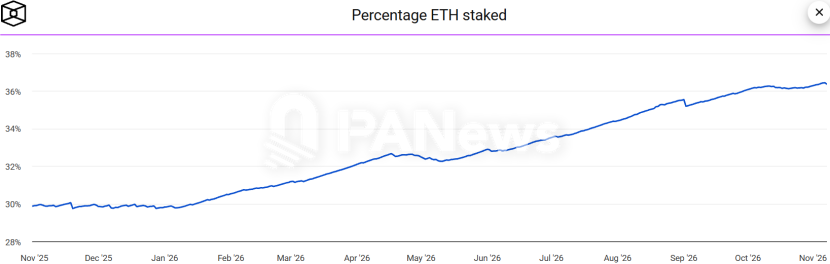
The most direct demand the article identifies is staking. Figures it attributes to The Block put staked ETH at 36.36 percent of circulating supply, compared with 29.91 percent the previous year. Tokens locked in validators are, on that reading, performing a network-security function rather than sitting in short-term speculative inventory. Those shares do not show why the marginal holder acquired ETH, or whether new activity requires fresh purchases.
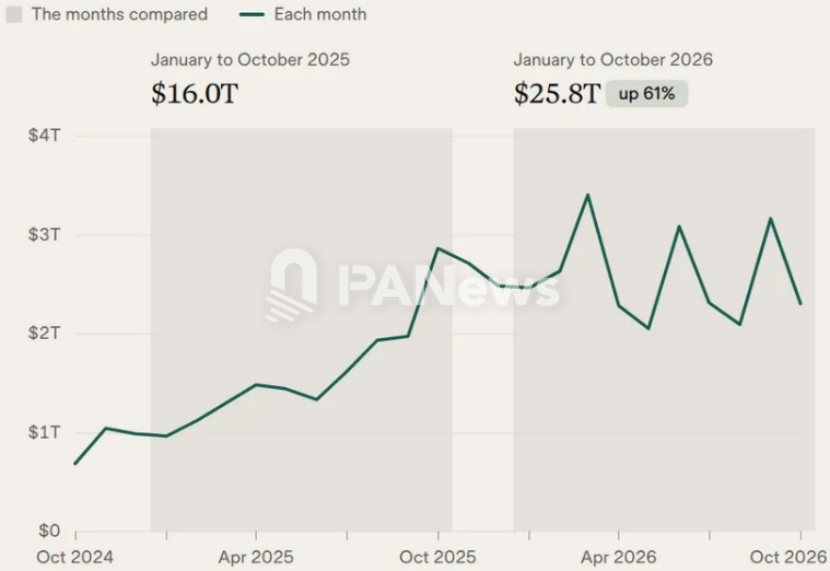
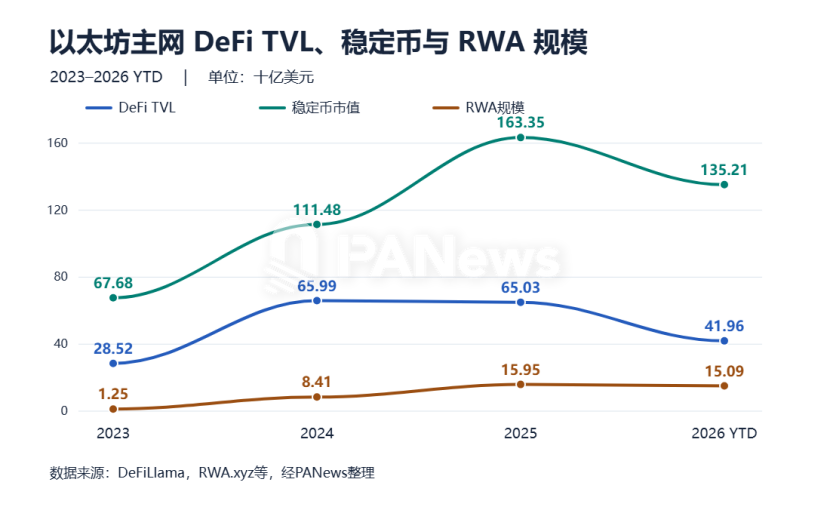
Other magnitudes in the report describe use of the base layer, not demand for the token. Research the article attributes to Ethereum Institutional put Ethereum mainnet stablecoin transfer volume in the first ten months of 2026 at $25.8 trillion, up 61 percent year over year. DeFiLlama figures in the same piece put mainnet DeFi total value locked at about $42 billion, stablecoin market capitalization above $135 billion, and real-world-asset scale at $15 billion. The article does not publish exact pull timestamps behind “to date” and “about,” so these are the magnitudes PANews assigned to those datasets, not a reconstructed series.
The gap the report stresses is structural. An institution can issue $1 billion of tokenized Treasuries on Ethereum while the collateral remains the off-chain bonds, the yield comes from coupons, and settlement is in USDC. The on-chain step may require only a small amount of ETH as gas. A larger stock of assets using Ethereum therefore does not, on this reasoning, imply net buying of ETH. That is the main test the article sets for the store-of-value claim.
Burn is still in the framework; the cash-flow arithmetic is not the market
The report does not drop fee burn. It calls gas destruction an important remaining pillar, and says the break in value transmission already appears in how little ETH is burned.
It attributes an illustration to Buterin: if a token burned $1 billion of fees a year, a 4 percent discount rate would imply a theoretical present value of about $25 billion. The article’s caveat is attached to that illustration. Transaction fees are not a stable cash flow, and treating a peak as the normal rate does not survive a cycle.
Run the other way, the same 4 percent rate and a market capitalization of about $260 billion would require Ethereum to burn about $10.4 billion of fees every year to “support” that capitalization. The report says this is already far from observed conditions. It is an implication of the discount-rate premise, not an independent valuation and not evidence that the market is using that model.
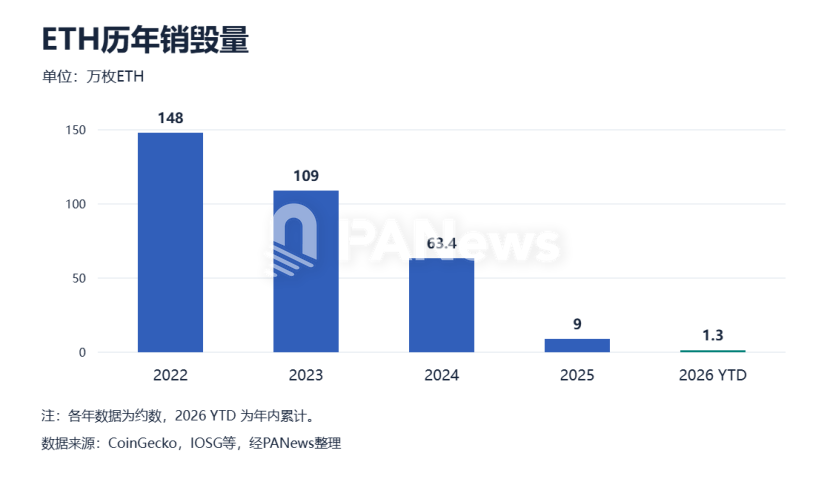
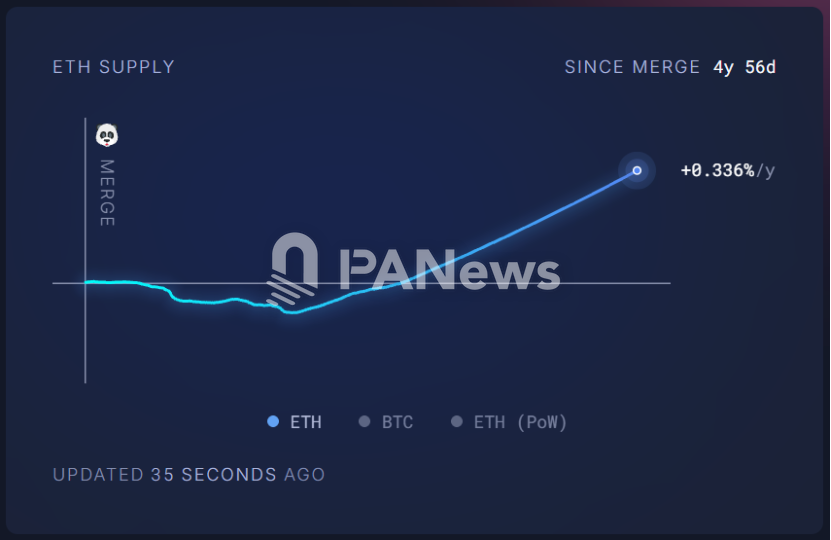
The burn quantities given are about 1.48 million ETH in 2022, versus about 13,000 ETH in 2026 up to the report, with a stated market value of about $27.3 million. By token count, the article describes a fall of more than 99 percent. It also says ETH had returned from net deflation to net inflation in February of the previous year—February 2025, given the November 2026 publication date—and that the inflation rate had kept rising. On that account, the deflationary promise associated with ultrasound money had already failed before the November 8 comment.
Where fee value is captured
The article treats the shift in who keeps the fees as a familiar problem, not a new discovery. If the ecosystem is viewed as one commercial system, base-layer revenue has been moving toward Layer 2s and the application layer.
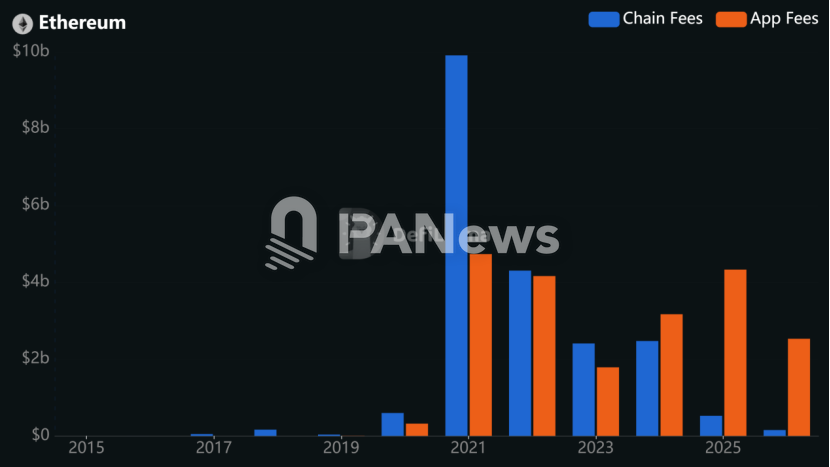
DeFiLlama data cited there say fees generated on the Ethereum chain were already overtaken by the application layer on mainnet in 2024. From the start of 2026 through the report, mainnet fees were about $152 million, while application-layer fees were $2.529 billion—more than 16 times the mainnet figure, as the article states.
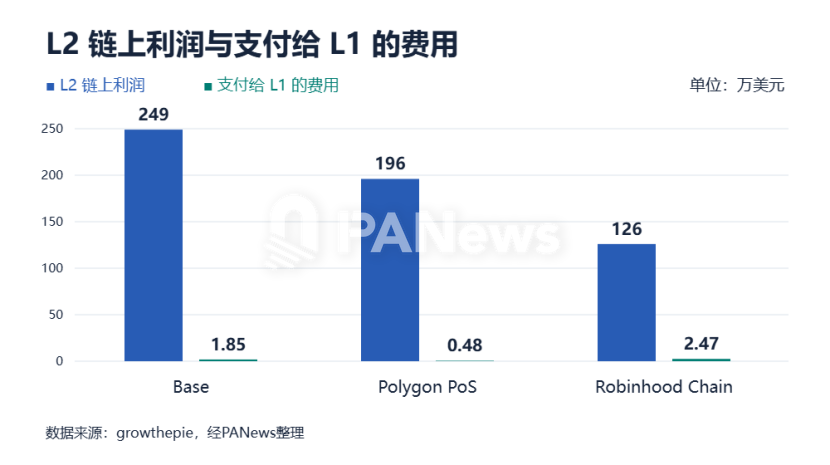
Base is the Layer 2 example. It uses Ethereum for underlying settlement and security, and it keeps a separate execution environment and user entry point. It charges end users, pays Ethereum for data publication and settlement, and retains the spread as on-chain gross profit.
growthepie figures for the 30 days before the report: the top three Ethereum Layer 2s together recorded about $5.71 million of on-chain profit, of which Base contributed $2.49 million. Over the same window, their combined settlement payments to Ethereum mainnet were only about $48,000, and Base’s payment was $18,500—lower, the article says, than Robinhood Chain’s. The report does not give Robinhood Chain’s amount. The inference drawn is that most fee value stayed on the Layer 2s, did not reach mainnet, and did not become yield for ETH holders.
A further, longer-horizon concern is brand and user perception, not a measured flow. If more users complete their activity entirely on Base, Arbitrum, or other Layer 2s and rarely touch Ethereum, the service and brand they recognize may belong to the Layer 2 or the front end rather than to ETH.
Lower fees are not automatically a loss of relevance
The report also records the opposite reading. Scaling reduces the cost of a transaction. When a transfer costs several dollars, many high-frequency and small-value uses are not viable. At a few cents or less, uses such as high-frequency payments by AI agents, micro-transactions, and automated strategies can at least become economically possible. Whether that demand grows large enough, through volume, to offset a lower fee per transaction is left explicitly unverified.
Tom Lee’s additional claim, as reported, is that a turn toward store of value would let ETH capture value in a coming tokenization and AI “supercycle.” That is a stated expectation, not a result measured in the article.
What the cited evidence settles
As of the November 10, 2026 report, three layers can be kept apart.
Documented in the named datasets: staking’s share of circulating supply was higher than a year earlier; stablecoin transfer volume, DeFi TVL, stablecoin capitalization, and real-world-asset scale were large; 2026 burn to date was a small fraction of 2022 burn; and recent Layer 2 on-chain profit was far larger than the settlement fees those chains paid to mainnet.
Not established by those figures: that users or institutions must buy and hold ETH in proportion to assets settled on Ethereum; that a 4 percent discount rate is the market’s model; or that cheaper fees will be offset by volume. The $10.4 billion annual burn implied by the capitalization arithmetic is a counterfactual under that premise, not a path the report says is underway.
The article’s closing judgment is about expectations, not a replacement cash flow. The older requirement was to show that Ethereum could collect enough fees to sustain burn. The requirement left open by the store-of-value framing is different: even if fees keep falling, ETH still has to be worth holding as base capital. The evidence assembled in the report shows the burn pillar weakening while measured usage stays large. It does not show that a store-of-value role has already produced net demand for ETH.
Original article by Jae, PANews, published November 10, 2026, 15:55 (UTC+8): https://www.panewslab.com/zh/articles/01a1c472-fa20-71cc-8de7-1175c01c5791