Historical-source note: This article is based on a TechFlow translation of an analysis by Spencer Applebaum, published on November 11, 2026, at 11:22 a.m. UTC+8. Figures and claims below reflect that reporting, not a current measurement.
AI-assisted development may make it easier to build a decentralized exchange or lending protocol. Applebaum’s argument is that this does not make a financial business equally easy to replicate. Code can be copied or generated; customers, loss-absorbing capital and information needed to price risk cannot be produced on demand.
The proposed framework has three potential sources of DeFi pricing power: distribution, capital and proprietary data. A fourth factor—willingness to enter markets incumbents avoid—may give a new project an opening, but is not necessarily a lasting moat.
Distribution: who directs the balances and trades?
Applebaum defines distribution as control over where customer orders or balances go. In his account, Hyperliquid’s large USDC margin balances gave it leverage in the stablecoin value chain. He says an arrangement involving its aligned quote asset framework and Coinbase directs roughly 90% of the relevant USDC reserve yield to Hyperliquid’s Assistance Fund for HYPE buybacks. On an estimated $5.5 billion balance subject to that share, he puts the annual revenue opportunity at approximately $185 million. That is the author’s estimate, dependent on balances and yield; it is not a fixed protocol revenue figure.
The same logic can favor a wallet over a trading venue. The article compares a MetaMask swap fee of up to 0.875% with Uniswap’s average trading fee of 0.13% over the preceding 12 months, while noting that much of the latter goes to liquidity providers rather than the protocol. It also says Phantom charged an additional five basis points for access to Hyperliquid perpetuals, on top of Hyperliquid’s native 4.5-basis-point rate.
Control of an interface is not automatically durable, however. The author points to fee competition among Hyperliquid front ends and the relative ease of moving a self-custodied wallet to another interface. His stronger distribution case is an established customer relationship that is harder to move, such as a funded account requiring onboarding and identity checks.
Capital: who can finance positions and absorb losses?
The article distinguishes mobile, incentive-driven liquidity from a balance sheet that can reliably finance trades or cover losses. It sees an opportunity for DeFi prime brokerage: traders now post separate margin across venues, even when positions could offset one another. Software may help coordinate collateral, but financing capacity, funding cost and liquidation risk remain difficult constraints.
Risk backstops illustrate the distinction. Applebaum cites Hyperliquid’s HLP vault, whose depositors share market-making returns and losses; he reports an approximately $4 million loss during the liquidation of a large ETH position in March 2025. Deposited third-party capital can leave for a better return. In the author’s view, retained earnings held by a protocol would provide a more durable backstop, though accumulating them takes time.
Proprietary data: what cannot be read on-chain?
Public collateral prices and liquidation rules make many crypto-backed lending strategies observable. Applebaum argues that this limits differentiation among managers using similar inputs. Citing DefiLlama, the article puts assets managed by risk curators on Morpho, Kamino and Euler at $9.5 billion and their average fee at 19 basis points; it puts Steakhouse Financial’s blended fee at 22 basis points.
He contrasts that market with OnRe’s reinsurance underwriting, which requires claims histories, contract terms and actuarial judgment unavailable from a block explorer. The article reports a 75-basis-point management fee plus 20% of excess returns for OnRe. Those fees are not a like-for-like measure of a data premium: the businesses carry different risks, including illiquidity and potential principal loss. They do, however, clarify the research question: whether a manager has information and underwriting ability that competitors cannot readily reproduce.
What the framework does—and does not—establish
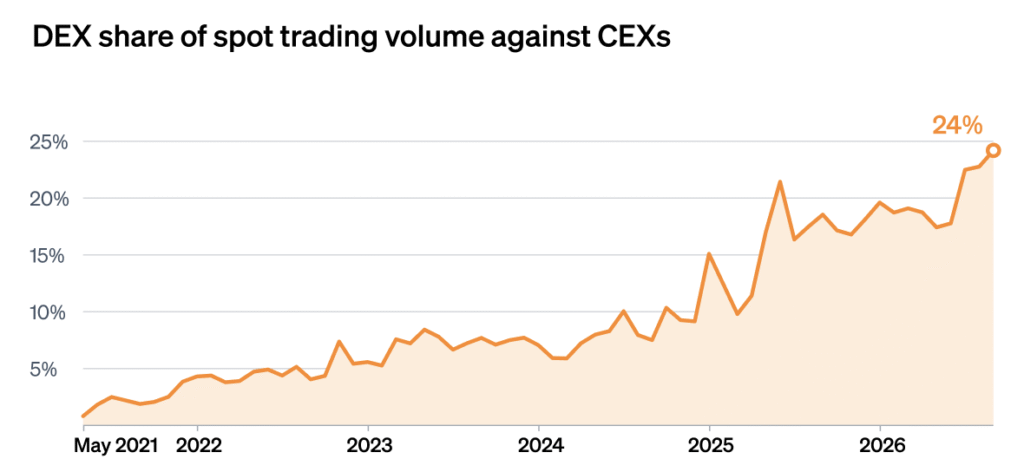
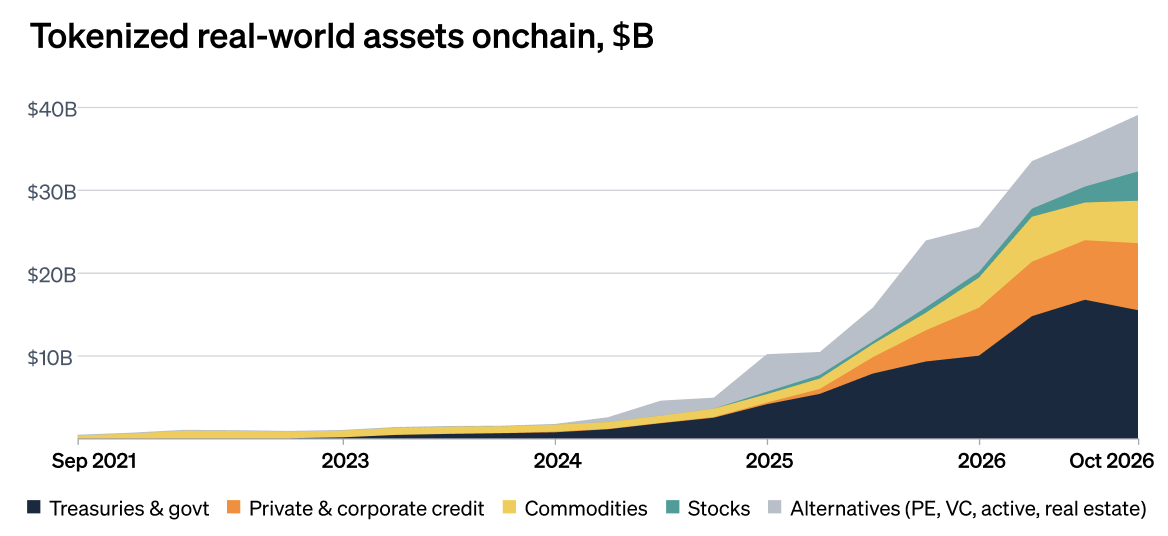
The argument challenges the assumption that existing DeFi protocols, or the chains hosting them, must capture most of any growth in on-chain finance. Applebaum cites a chart from The Block and DefiLlama showing DEX spot volume reaching 24% of CEX spot volume, alongside rwa.xyz data on tokenized real-world assets. These are indicators used in his thesis, not proof that a particular token or application will capture the resulting value.
Nor is risk-taking alone a moat. The article presents projects entering markets that larger firms may avoid as examples of how a new entrant might gain users or expertise. Its more demanding test is whether that opening becomes a durable customer relationship, a dependable balance sheet or defensible underwriting capability. Lower development costs do not, by themselves, answer that question.
Source: techflowpost.com (originally published 2026-11-11 11:22 UTC+8)