Originally reported on November 11, 2026. This article examines Uniswap’s account of a US securities exemption; the source does not provide the order itself or an independently verified dataset.
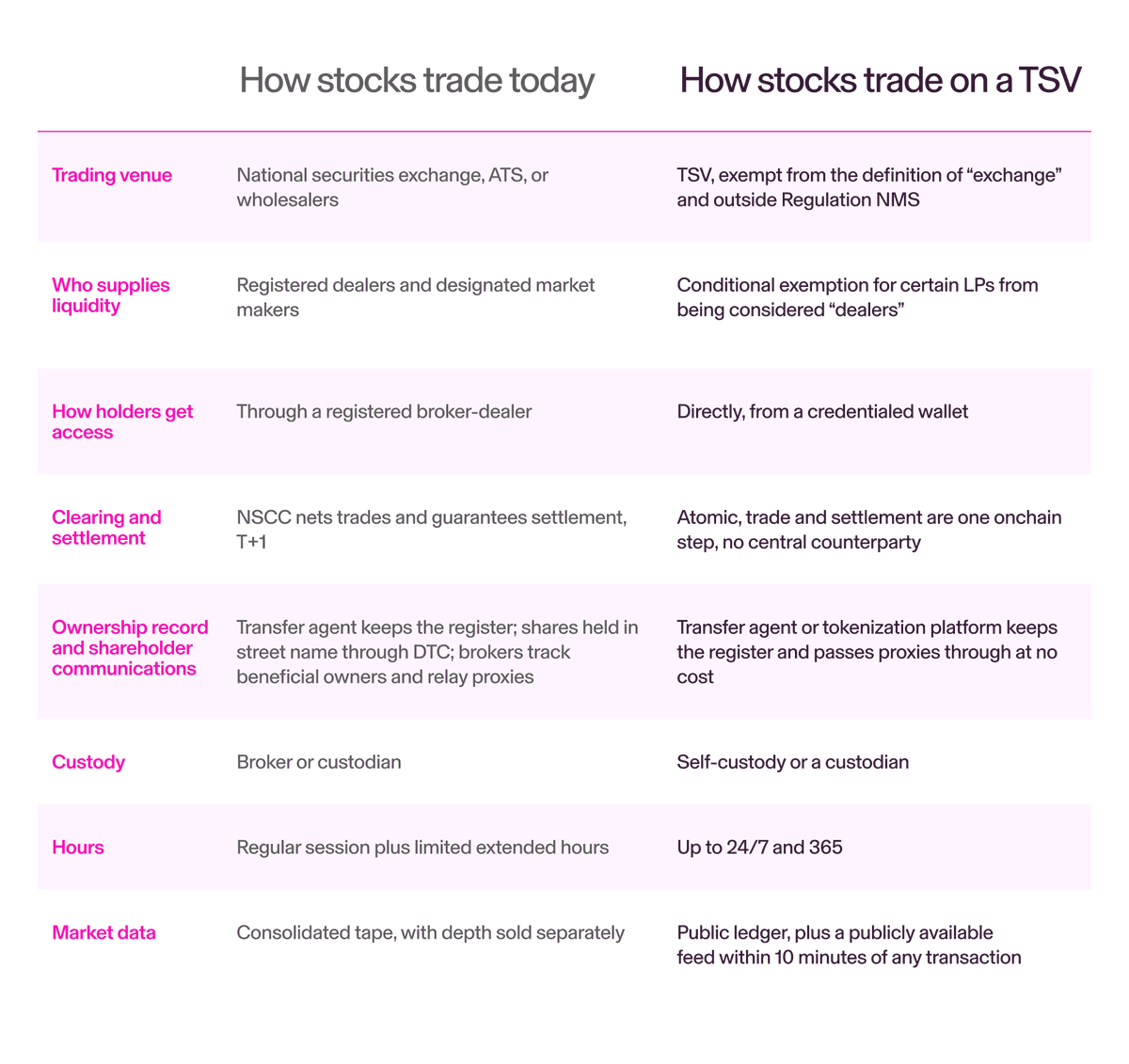
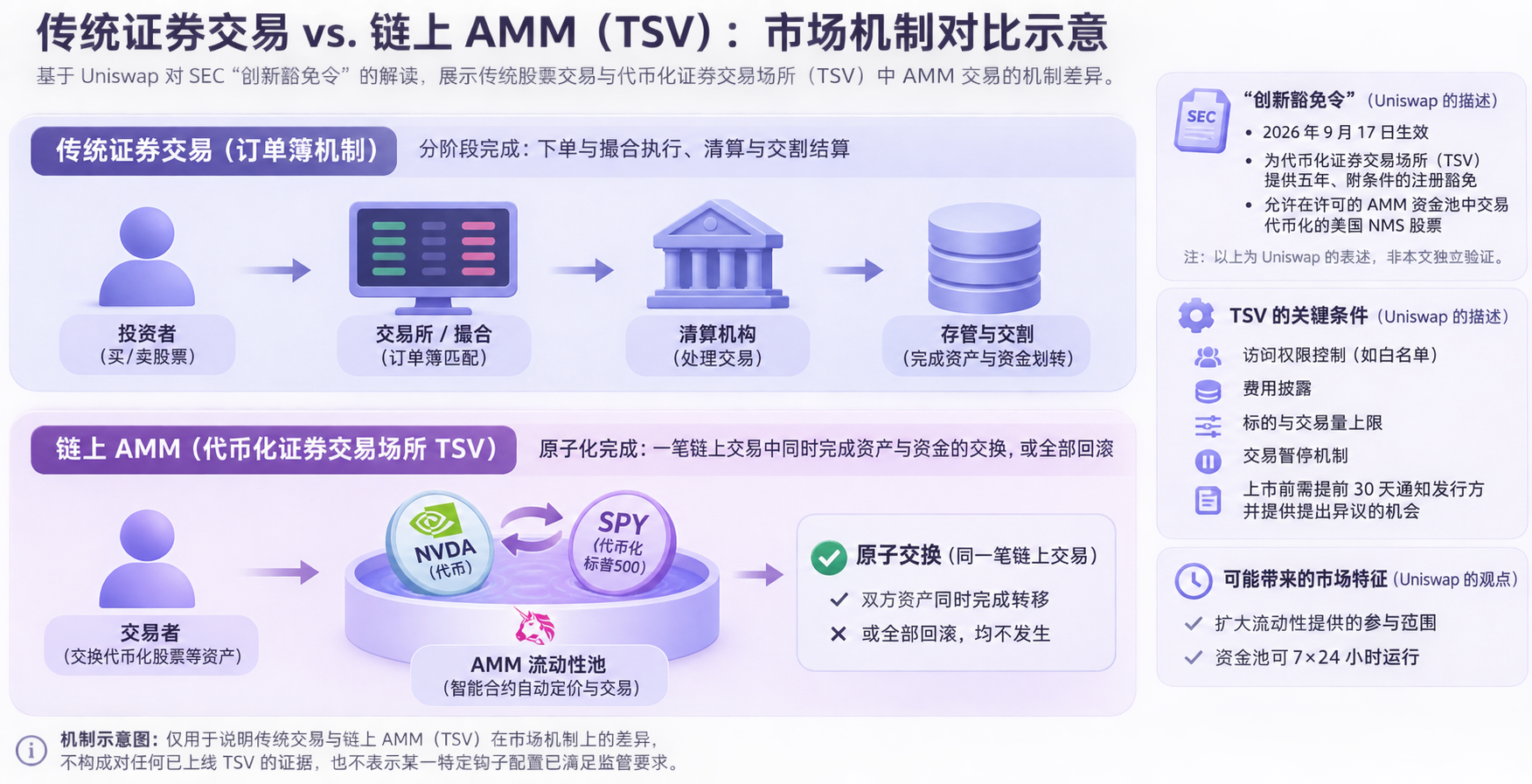
Uniswap says an SEC “innovation exemption” took effect on September 17, 2026, creating a five-year, conditional exemption for tokenized securities venues (TSVs). In its account, qualifying venues could trade tokenized US National Market System stocks through permissioned automated market maker (AMM) pools without registering as securities exchanges or alternative trading systems. Liquidity providers meeting the order’s conditions would not be treated as securities dealers. These are Uniswap’s descriptions of the regulatory framework, not findings independently established by the supplied article.
What changes in the market mechanism?
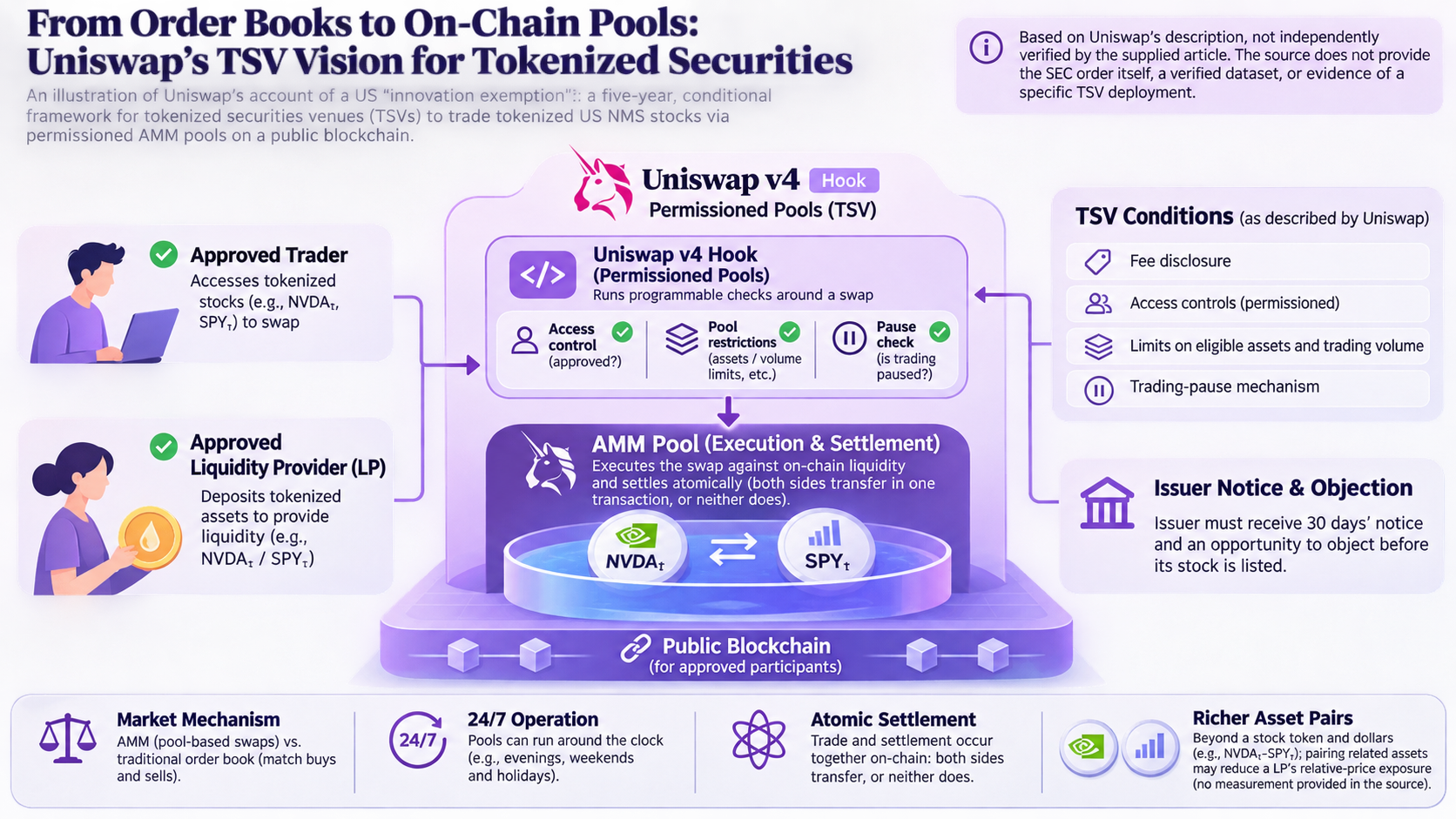
An AMM executes swaps against assets deposited in a smart-contract pool rather than matching orders in an order book. Uniswap argues that this could broaden participation in liquidity provision and allow pools to operate around the clock. It also describes pairs beyond a stock token and dollars—for example, an NVIDIA-linked token paired with a tokenized S&P 500 fund. Pairing assets whose prices move together may reduce a liquidity provider’s relative-price exposure, but the article supplies no measurement of that effect.
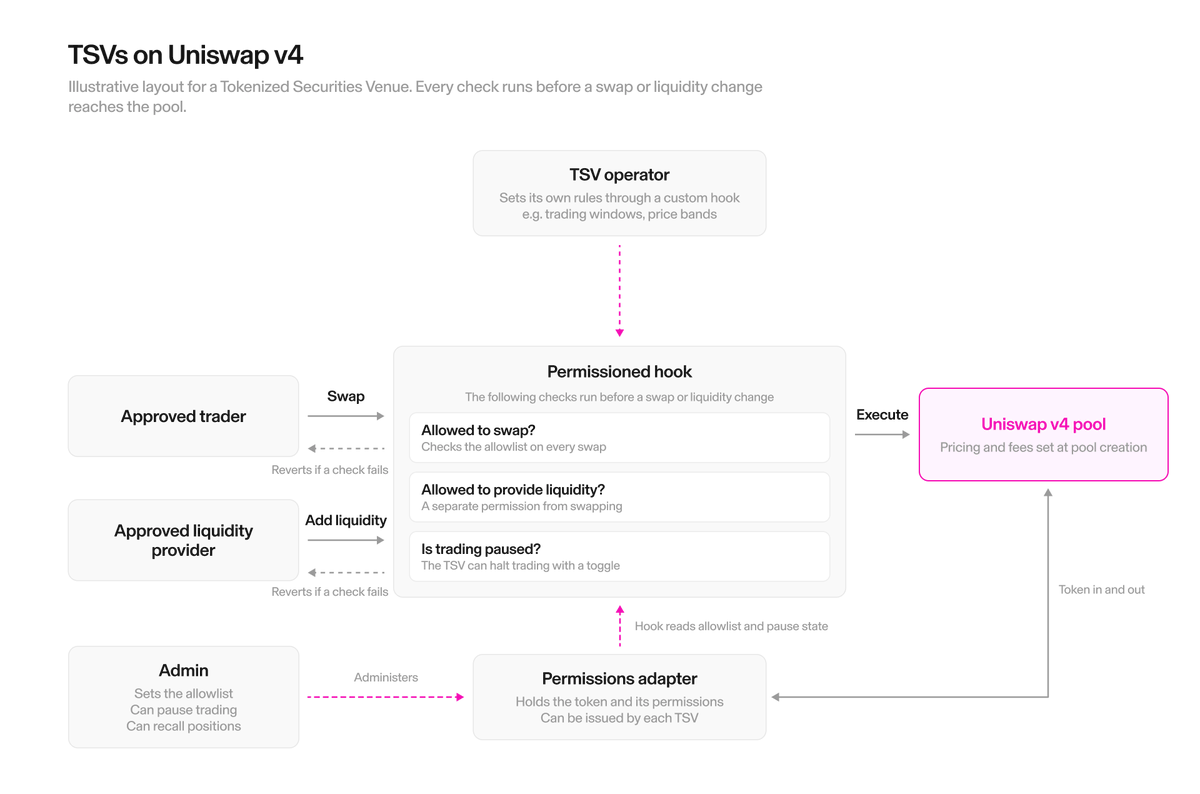
Under Uniswap’s proposed TSV model, approved participants would access pools on a public blockchain. The source describes a swap and its on-chain settlement as atomic: both sides transfer in one transaction, or neither does. It says an issuer must receive 30 days’ notice and an opportunity to object before its stock is listed. The stated exemption conditions also include fee disclosure, access controls, limits on eligible assets and trading volume, and a trading-pause mechanism.
The implementation question is how those conditions are enforced. Uniswap v4 hooks are programmable code that can run at specified points around a swap. Uniswap presents its Permissioned Pools hook as a way for a venue operator to control access and apply pool-level restrictions while the underlying protocol executes trades. The article does not document a particular TSV deployment or demonstrate that a hook configuration satisfies the order’s legal requirements. Uniswap Labs says it does not operate such venues; operators remain responsible for their design and compliance.
Evidence and limits
Uniswap reports more than $20 billion in cumulative tokenized-stock trading volume on its protocol as of the November 11 report, mainly associated with Robinhood Stock Tokens and xStocks and issuers including Ondo and Dinari. It also says that, following the launch of ten tokenized stocks and ETFs quoted against SPY on Robinhood Chain in August 2026, more than 40 assets had SPY pools, generating over $900 million in volume across 130,000 wallet addresses by the time of its report. The source does not supply the underlying dataset, measurement method or a more precise cutoff for those figures. Volume and wallet counts alone do not establish how many distinct people traded or what rights each token confers.
The distinction matters: the source describes stock exposure already trading on-chain, while shareholder rights are presented as a possible next step—not an established feature of every token. The exemption is likewise described as temporary, conditional and subject to change.
Original article, translated by TechFlow from Uniswap (November 11, 2026)