Originally reported November 11, 2026, at 20:30 UTC+8. The figures below reflect the periods specified in the original article, not current measurements.
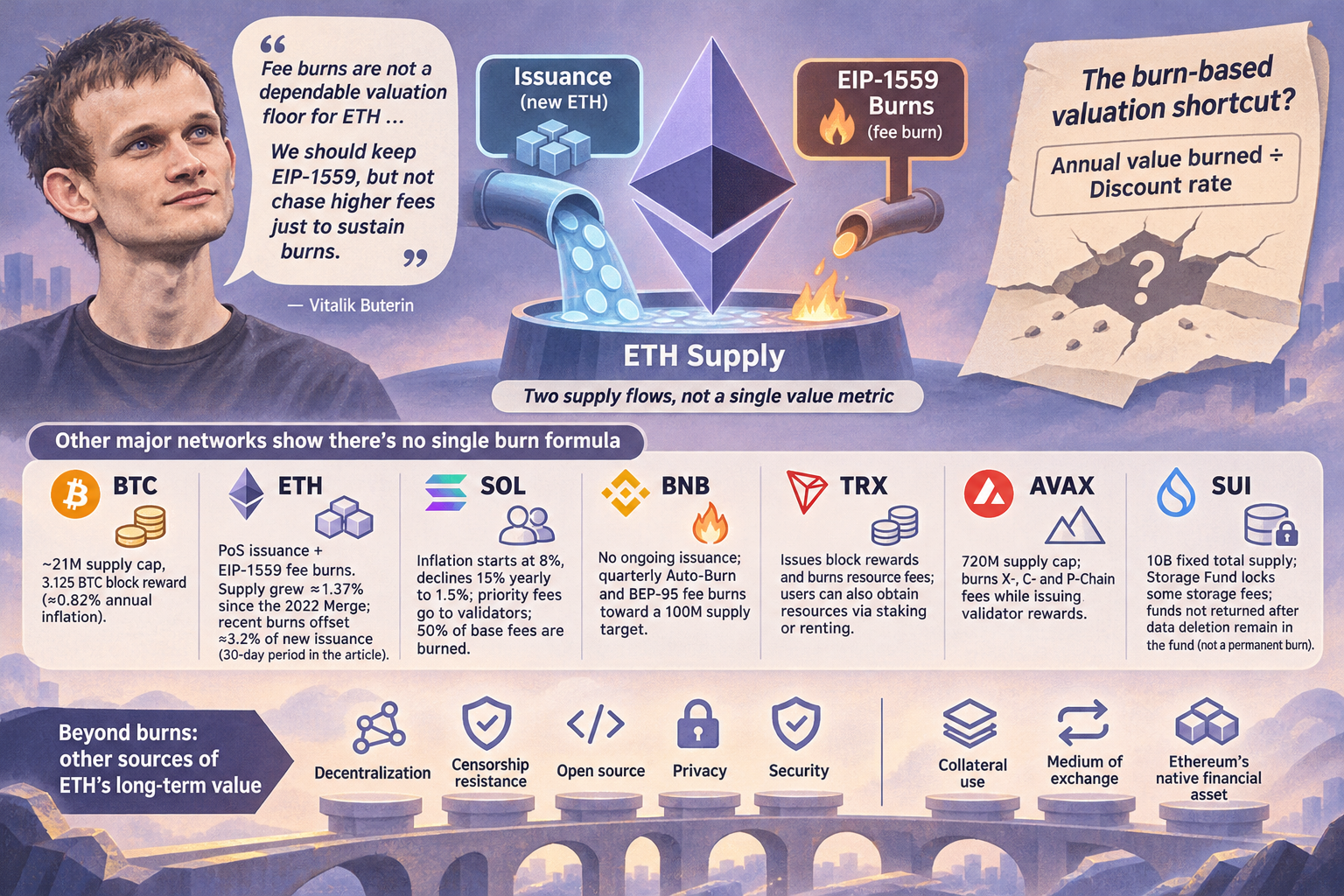
In a November 8 X post discussed by Odaily, Vitalik Buterin questioned whether fee burns provide a dependable valuation floor for ETH. His concern was that much of the fee revenue behind earlier burns came from speculation within crypto markets and could shrink when activity cooled. He continued to support EIP-1559, but argued that Ethereum should not pursue higher fees merely to sustain burns—even if burns remained below 10% of new issuance for an extended period.
What issuance and burns actually measure
The article reports that ETH supply had grown about 1.37% cumulatively since the 2022 Merge. Over the 30 days preceding its report, burns offset only about 3.2% of new issuance. That is a change in the relationship between two supply flows, not a direct measure of everything users value about Ethereum.
Other networks illustrate why a single burn metric cannot describe token supply or value capture across chains:
| Network | Supply mechanism and reported measurement |
|---|---|
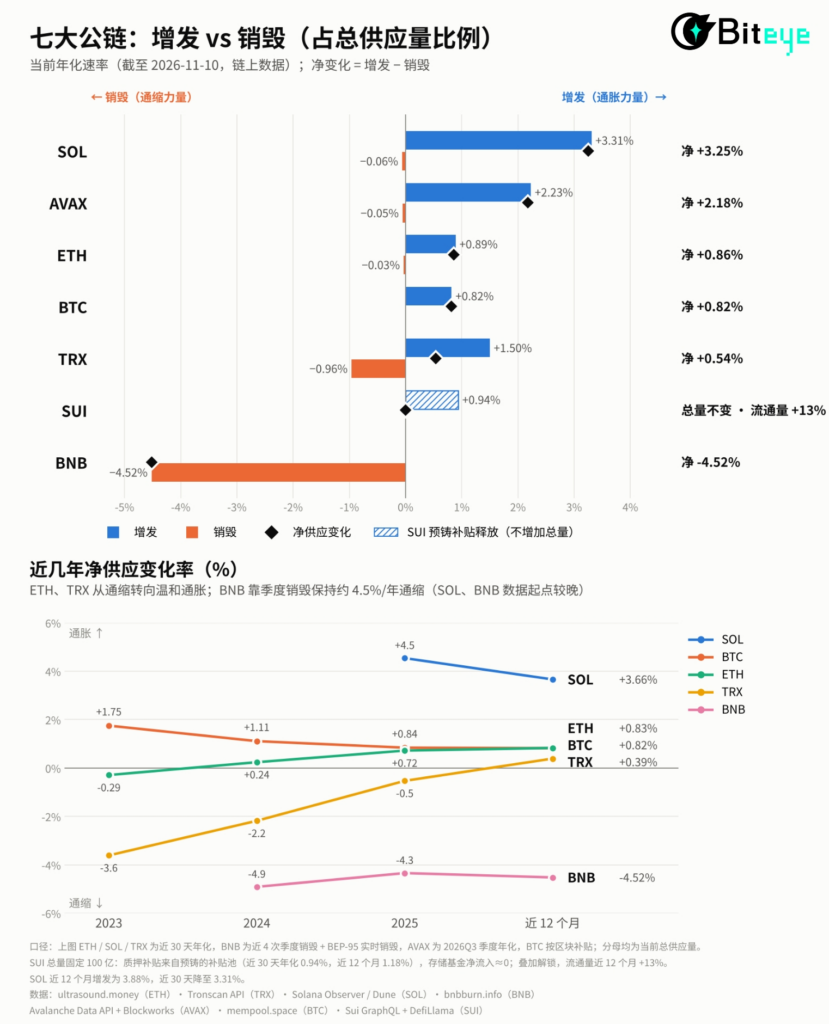
| BTC | With a roughly 21 million-coin cap and a 3.125 BTC block reward, the article estimates about 164,300 BTC in annual issuance at a ten-minute average block interval—roughly 0.82% annual supply inflation. |
| SOL | Solana’s stated inflation schedule began at 8% annually, declines by 15% each year and targets 1.5% over the long term. Following SIMD-0096, priority fees go to validators; 50% of base fees are burned. The article says daily burns subsequently fell at one point to about 700 SOL. |
| BNB | Rather than relying on continuing issuance, BNB supply falls through quarterly Auto-Burn and BEP-95 fee burns, toward a 100 million-token target. The article reports approximately 6.2 million BNB burned across the first four quarterly burns of 2026. |
| TRX | TRON issues block rewards and burns resource fees users pay. Because users can also obtain resources through staking or renting, more USDT transfers need not produce a proportional rise in TRX burns. |
| AVAX | AVAX has a 720 million-token supply cap and burns X-, C- and P-Chain fees while issuing validator rewards. As of early November 2026, the article reports roughly 474 million AVAX minted, including about 114 million in staking rewards, against about 5.18 million burned cumulatively. |
| SUI | SUI has a fixed 10 billion-token total supply, with circulating supply affected by unlocks. Its Storage Fund locks some storage fees; funds not returned after data deletion remain in the fund. That reduces freely circulating supply but is not a permanent burn. |
These mechanisms also direct fees to different recipients. The article notes that SOL priority fees accrue to validators, while TRX resource rentals can benefit stakers. Neither flow is fully represented by a burn total.
Testing the burn-based valuation shortcut
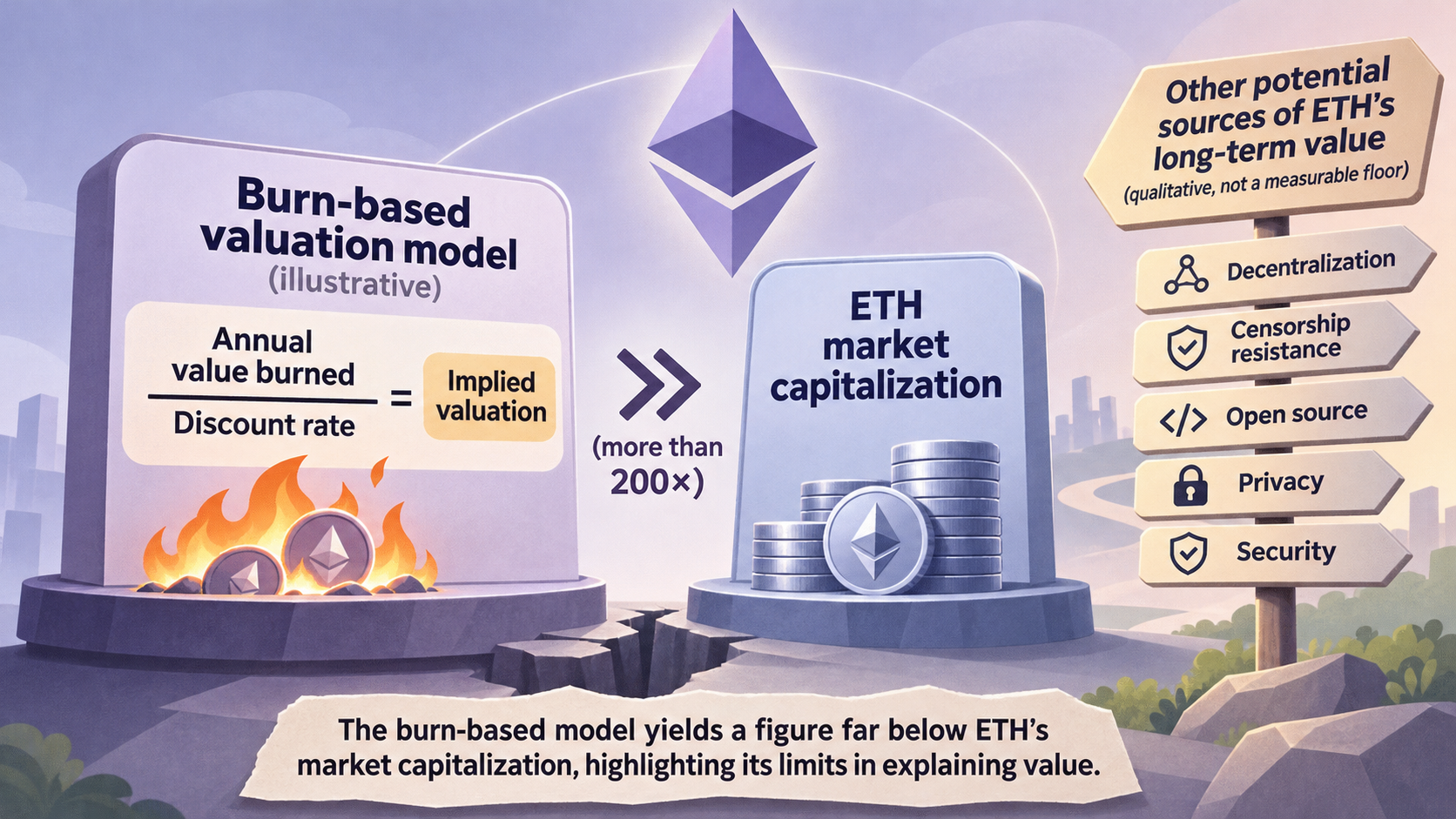
The article examines a simplified model: annual value burned ÷ discount rate. At $1 billion burned annually and a 4% discount rate, it yields $25 billion. The calculation assumes a durable annual flow—precisely what Buterin disputes.
For ETH, the article reports approximately 1.48 million ETH, worth about $3.6 billion, burned in 2022. From the start of 2026 through November 8, it reports about 19,200 ETH, worth roughly $43 million, burned. Annualizing the latter figure to approximately $50 million and applying the same 4% rate produces about $1.25 billion, versus an ETH market capitalization of roughly $270 billion at the time—a gap of more than 200 times. Those are the article’s illustrative inputs, not an independently verified valuation dataset; their gap shows how little this particular model explains, not what ETH should be worth.
Buterin instead emphasized decentralization, censorship resistance, open source, privacy and security as potential sources of long-term value. The article also raises possible demand for ETH as collateral, a medium of exchange and Ethereum’s native financial asset. Those possibilities do not supply a comparable, measurable valuation floor. Nor does the burn calculation resolve the separate question of how holders should assess long-term trust in ETH’s upgradeable issuance rules.
Source: odaily.news (originally published 2026-11-11 20:30 UTC+8)