Historical report: originally published November 10, 2026, at 18:00 UTC+8. The platform and market figures below reflect the reporting available at that time.
The New York Stock Exchange’s planned round-the-clock tokenized-securities platform had selected Avalanche technology for its settlement ledger, according to November 9 reporting by The Wall Street Journal, an Ava Labs announcement and NYSE information released that day. The platform was targeting a fourth-quarter launch subject to regulatory approval. Its selection of Avalanche technology did not, by itself, establish a transaction-linked source of revenue for AVAX.
One settlement ledger, potentially multiple issuance chains
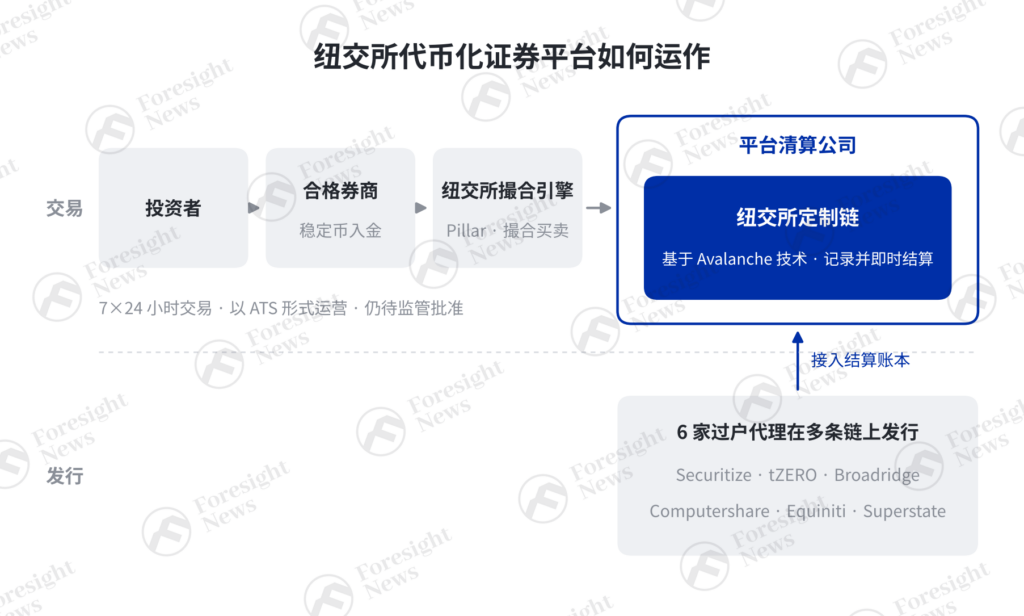
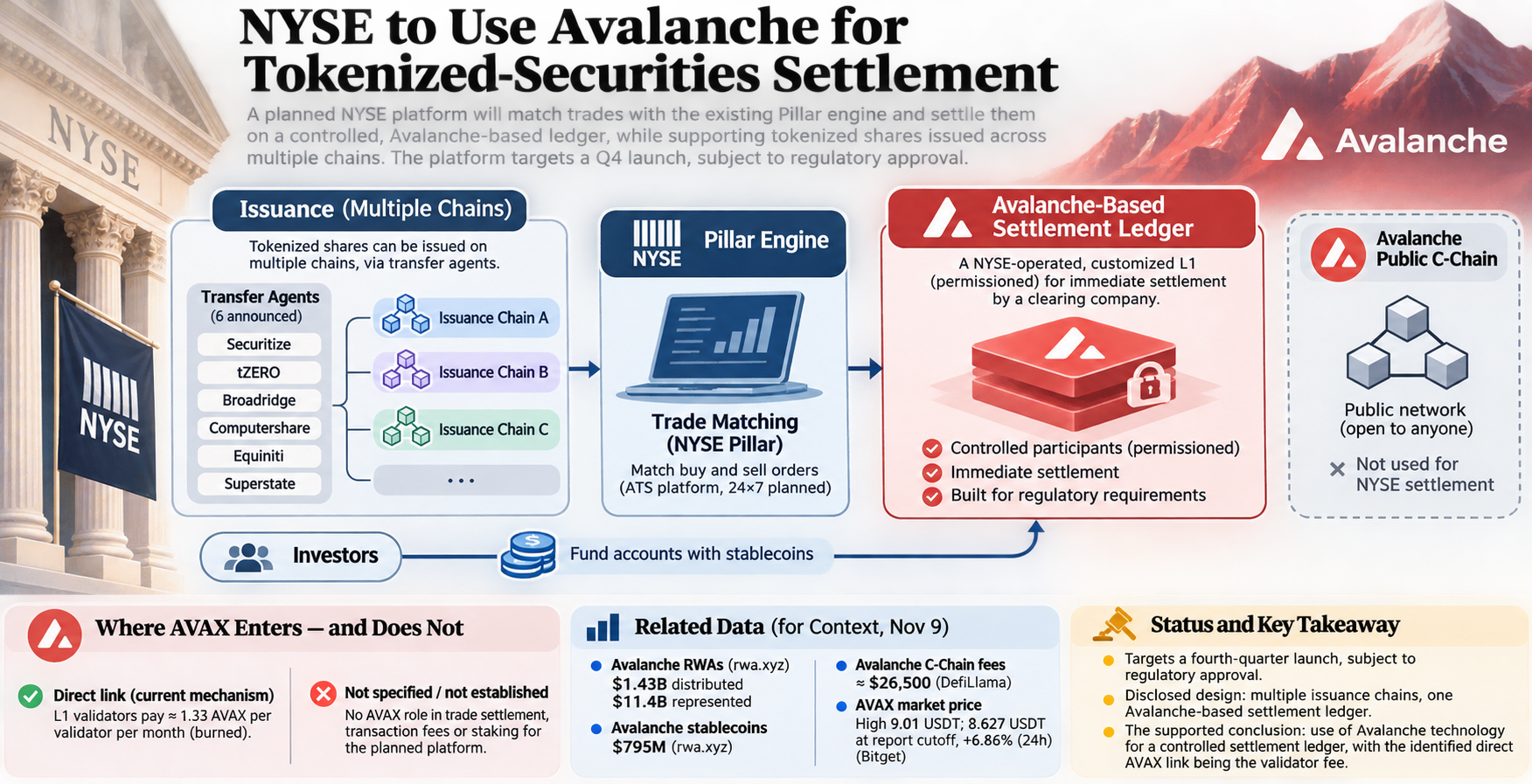
Under the disclosed design, NYSE’s existing Pillar engine would match trades. A clearing company would then settle them immediately on an Avalanche-based ledger, while investors could fund accounts with stablecoins. Ava Labs chief business officer John Nahas said settlement would take place on a blockchain customized for regulatory requirements—not on Avalanche’s public C-Chain.
NYSE digital issuance head Dennis Lee said the platform could support shares issued across multiple chains, while using one ledger to record and settle trades. NYSE had announced six transfer-agent partners by November 2: Securitize, tZERO, Broadridge, Computershare, Equiniti and Superstate. According to the reported plan, both custodian-issued and issuer-issued tokens would be interchangeable with conventional shares and carry the same dividend and voting rights.
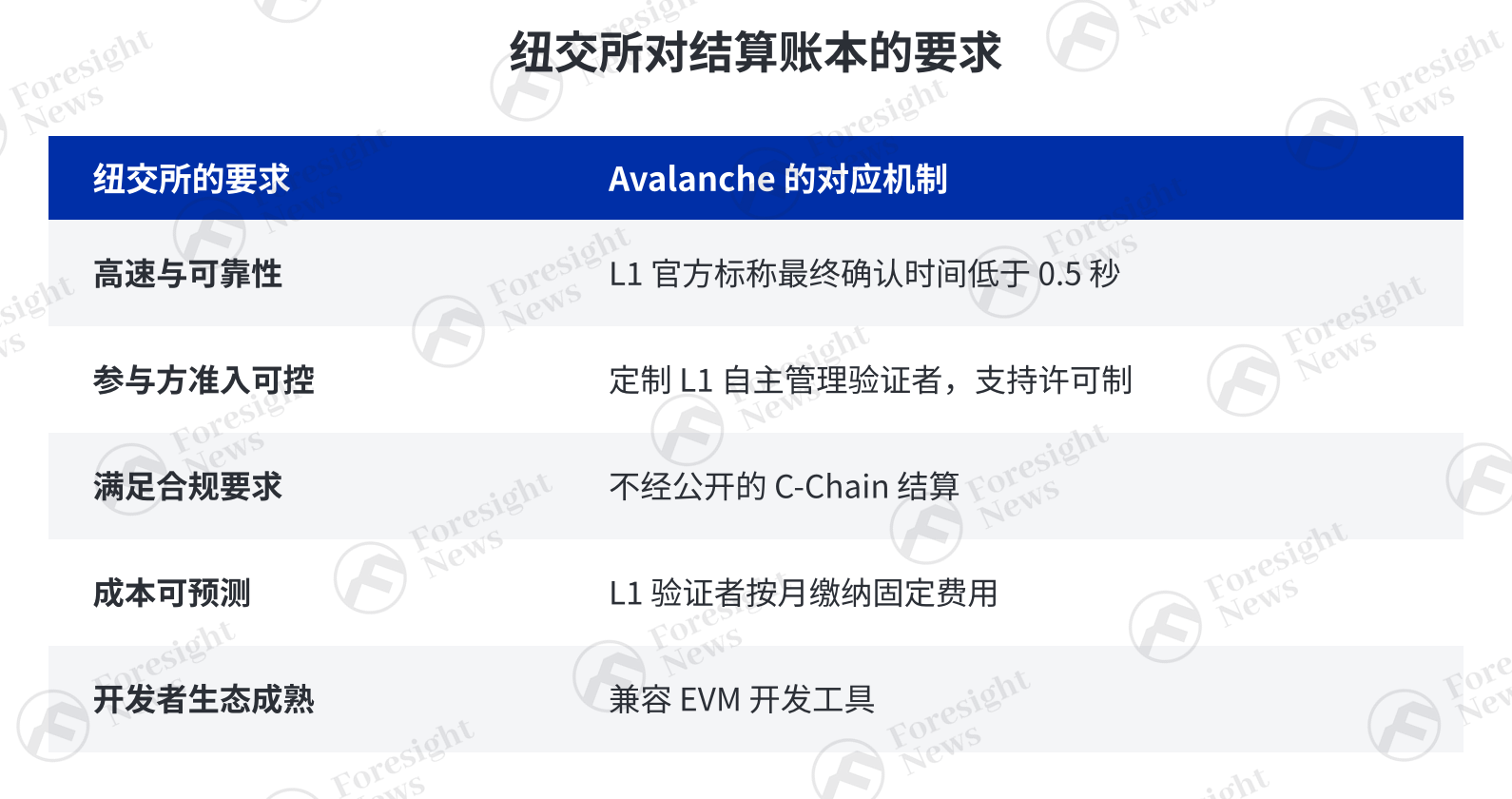
The distinction between issuance and settlement matters here. Lee cited control over participants, reliability, speed, predictable costs and developer support among the ledger requirements. A public chain open to anyone would not provide the participant controls described for this settlement system. Avalanche’s custom L1 model instead lets an operator manage its own validator set and run a permissioned network. Ava Labs CEO Emin Gün Sirer said such infrastructure could still connect to a wider asset and liquidity ecosystem through cross-L1 messaging; that is a statement about the technology’s capabilities, not evidence that the planned platform had already established those connections.
NYSE announced development of the platform and its pursuit of regulatory approval on January 19. Its parent, Intercontinental Exchange, signed a memorandum of understanding with tZERO on August 31. Ava Labs president Charley Cooper said at September’s Avalanche Summit that NYSE had tested Avalanche for roughly a year; the selection had not yet been announced then. On November 9, Cooper described the planned deployment as production-oriented rather than another pilot.
Where AVAX does—and does not—enter the design
Neither the Ava Labs announcement nor NYSE’s statement specified an AVAX role in trade settlement, transaction fees or staking. Under the existing custom-L1 mechanism described in Avalanche documentation, validators pay an ongoing fee denominated in AVAX. With fewer than 10,000 L1 validators, the documented rate was approximately 1.33 AVAX per validator per month, which is burned. It does not scale with the number or value of settled trades; an L1 operator may also choose the token used for its own transaction fees. Custom-L1 validators need not first stake 2,000 AVAX as mainnet validators.
The Avalanche Foundation had already identified this value-capture gap. In its July 30 economic-research agenda, it said ecosystem value does not automatically accrue to AVAX. Its August 12 estimate put cumulative C-Chain fee burns since early 2024 at approximately $23.5 million, excluding L1 validator fees. Revenue-sharing mechanisms for L1s remained under research, not enacted rules.
The foundation’s latest monthly figures in that estimate were for June: $3.1 million in nominal on-chain gross chain product, $2.7 million in returns to holders of assets such as tokenized funds, and $6.9 million in issuer earnings from reserve assets. The foundation considered the latter two categories to contribute little to AVAX value capture at the time. Its listed research directions included validator-voted gas-price changes under ACP-283, a protocol-owned stablecoin under ACP-67, and application and L1 revenue sharing. None was presented as an implemented source of revenue from NYSE settlement.
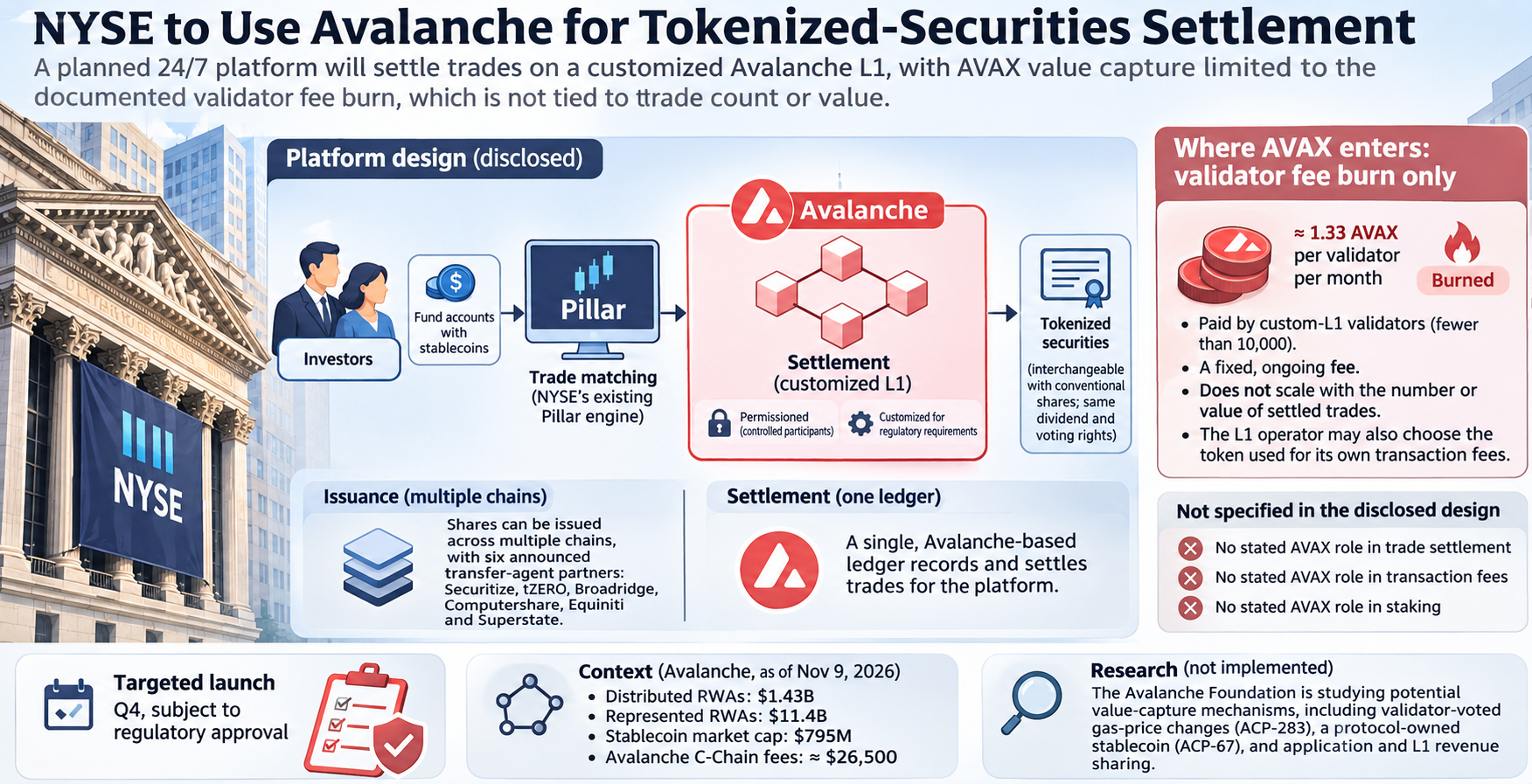
For scale and context—not as a forecast of platform use—rwa.xyz reported $1.43 billion in distributed RWAs, $11.4 billion in represented RWAs and $795 million in stablecoin market capitalization on Avalanche as of November 9. DefiLlama put Avalanche C-Chain fees on November 9 at about $26,500. Bitget market data cited in the original report showed AVAX reaching 9.01 USDT after the news and trading at 8.627 USDT at the report’s cutoff, up 6.86% over 24 hours. Those observations do not measure revenue from the planned settlement chain.
The supported conclusion is narrower than the market reaction: the disclosed design would use Avalanche technology for a controlled settlement ledger, while the identified direct AVAX link under the existing mechanism was the validator fee. The platform still required regulatory approval before its targeted launch.
Source: odaily.news (originally published 2026-11-10 18:00 UTC+8)