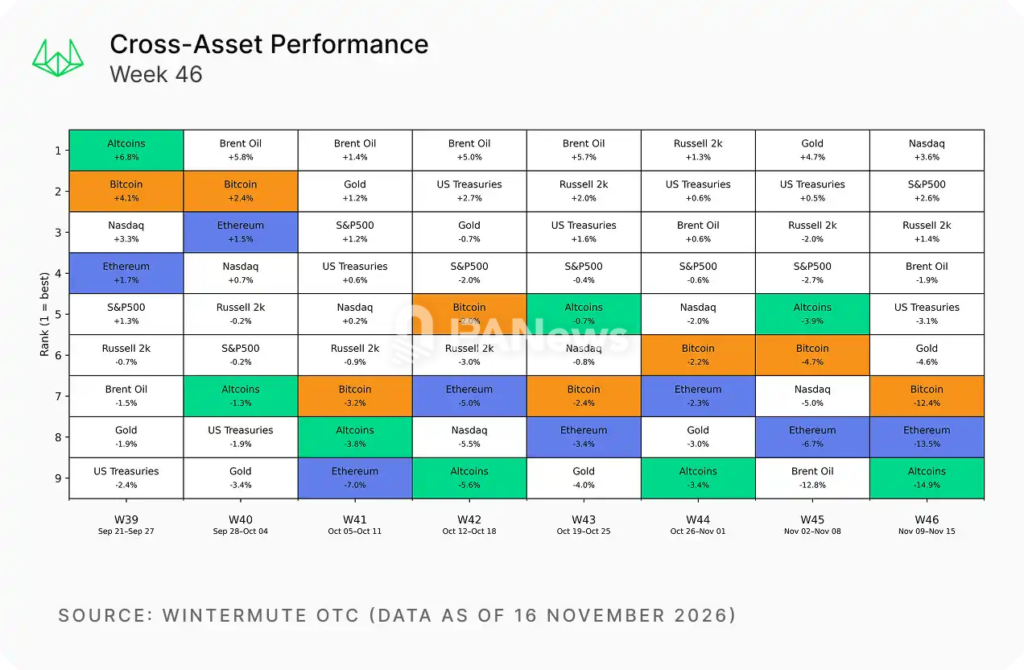
In an analysis published on November 18, 2026, Wintermute argued that Bitcoin’s rebound from its July low had failed and that the bear market was not over. Its case rests on three observations: Bitcoin had fallen below a long-term moving average, previously important sources of buying had weakened, and recent liquidations had not established that fresh capital was entering the market. The firm saw a possible move toward the $50,000 range, not a confirmed price target or a known market bottom.
The funding picture
Wintermute reported that US spot Bitcoin ETFs had recorded approximately $1.9 billion in net outflows in 2026 to date, compared with roughly $21 billion in net inflows in 2025 and $35 billion in 2024. It also said aggregate stablecoin supply had fallen by approximately $14 billion–$16 billion over the preceding 30 days. The analysis does not identify the datasets or calculation methods behind those figures, so they should be read as Wintermute’s reported measurements rather than independently verified flow data.
Wintermute also argued that buying by digital-asset treasury companies was weakening. It said MSCI was set to remove Strategy from an index after the November 30 close, and that Bitcoin’s spot price was about 14% below Strategy’s approximately $75,500 average purchase cost. In Wintermute’s assessment, pressure on the premium of such companies’ shares to the net value of their crypto holdings could make further equity-financed purchases harder.
Why Wintermute did not call a bottom
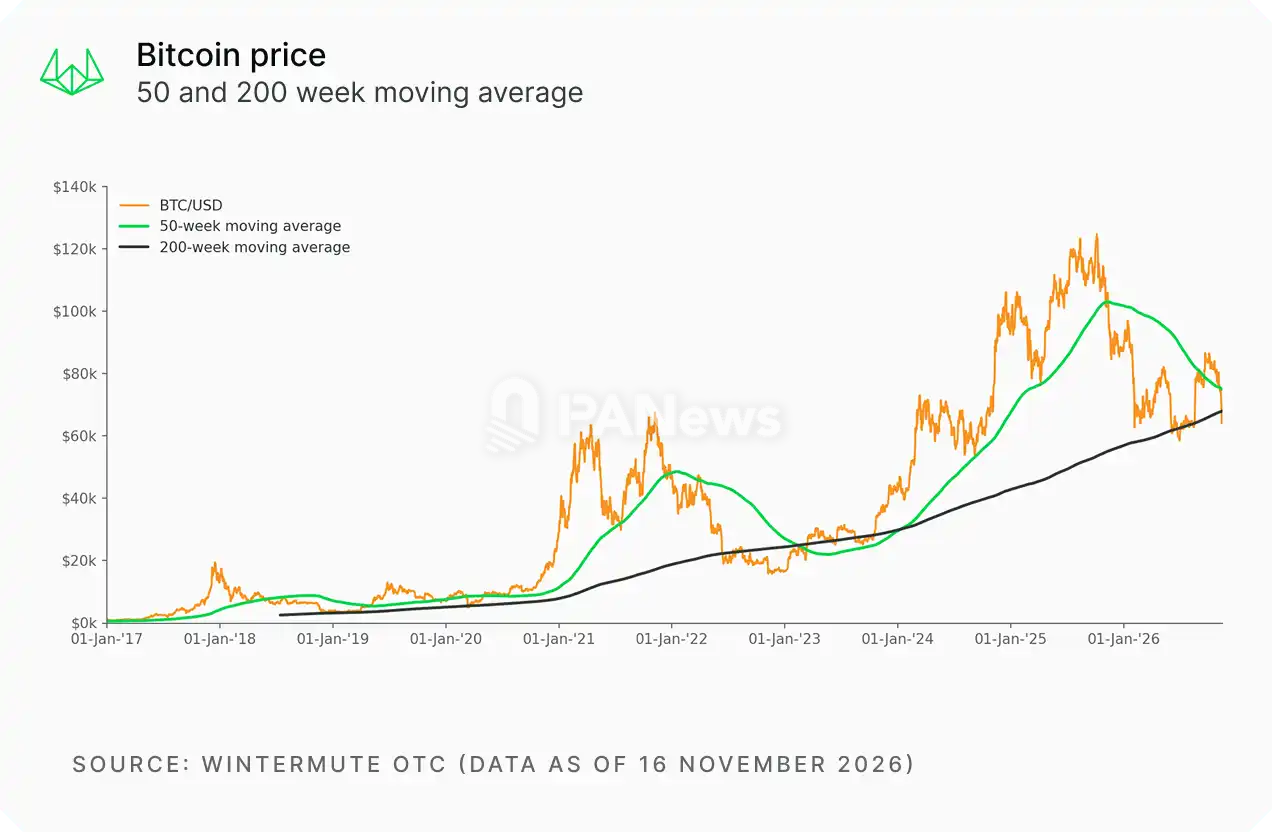
Bitcoin had fallen through $80,000 and its 50-week moving average, then closed below its roughly $68,000 200-week moving average, according to the analysis. Wintermute said it had reached $62,000 the preceding Saturday, its lowest level since July. The firm treated $68,000 as potential resistance on a rebound.
Wintermute reported approximately $1.7 billion in crypto liquidations over the 24 hours ending Sunday, about 80% of them long positions, while funding rates on major trading platforms had turned negative. It interpreted the subsequent bounce as more likely driven by short covering than by new buying. That is an interpretation, not proof of what caused the move. The firm also said altcoin open interest remained close to twice Bitcoin’s, leaving further leverage to unwind in its view.
Rates, risks and conditions for a reversal
Wintermute linked the sell-off to higher interest-rate expectations. It cited a third consecutive monthly 0.3% rise in US core CPI, a roughly 92% market-implied probability of a December rate increase, and a 5.15% US 10-year Treasury yield, up about 30 basis points over the week. It reported Bitcoin down 12.7% over the preceding week to $65,400, while the S&P 500 rose 2.5%. Wintermute’s explanation was that rate repricing had put particular pressure on a volatile asset that pays no yield.
The firm identified $62,000 as the first nearby price level to watch and $60,000 as an area of concentrated Deribit put-option strikes. It said a move toward the $50,000 range remained possible, while explicitly declining to predict an absolute bottom.
Wintermute said it would reconsider its short-term defensive stance if Bitcoin reclaimed the approximately $68,000 200-week average on a confirmed daily close and spot Bitcoin ETFs returned to net inflows that day. Alternatively, Federal Reserve minutes or October PCE inflation data that removed market expectations of a January rate increase could ease the rate pressure behind its thesis. Until then, its central distinction was between a price rebound and a rebound supported by sustained capital inflows.