As reported on November 19, 2026, Bitcoin had fallen back toward $62,000 for the second time in a week, while Ether had dropped below $1,750 and touched $1,735. The immediate question for market participants was not only whether $62,000 would hold, but whether prospective Federal Reserve rate increases would keep pressure on risk assets and leave a rebound short of buyers.
Rate expectations, not a rate decision
Federal Reserve Governor Christopher Waller told CNBC that inflation was moving in the wrong direction and that price pressures had spread into services. He favored a 50-basis-point increase in December 2026, though he said a 25-basis-point move could work if the Fed clearly signaled another 25-basis-point increase in January 2027. Those were policy preferences, not decisions.
Minutes of the Fed’s October meeting showed a similar debate over pace. After a 25-basis-point increase in September, officials held rates at 3.75%–4.00% in October. Governor Lisa Cook and Cleveland Fed President Beth Hammack dissented in favor of an immediate increase. Almost all participants expected further increases over the following months if the economy developed as anticipated; two raised the possibility of a December move larger than 25 basis points if subsequent inflation data disappointed.
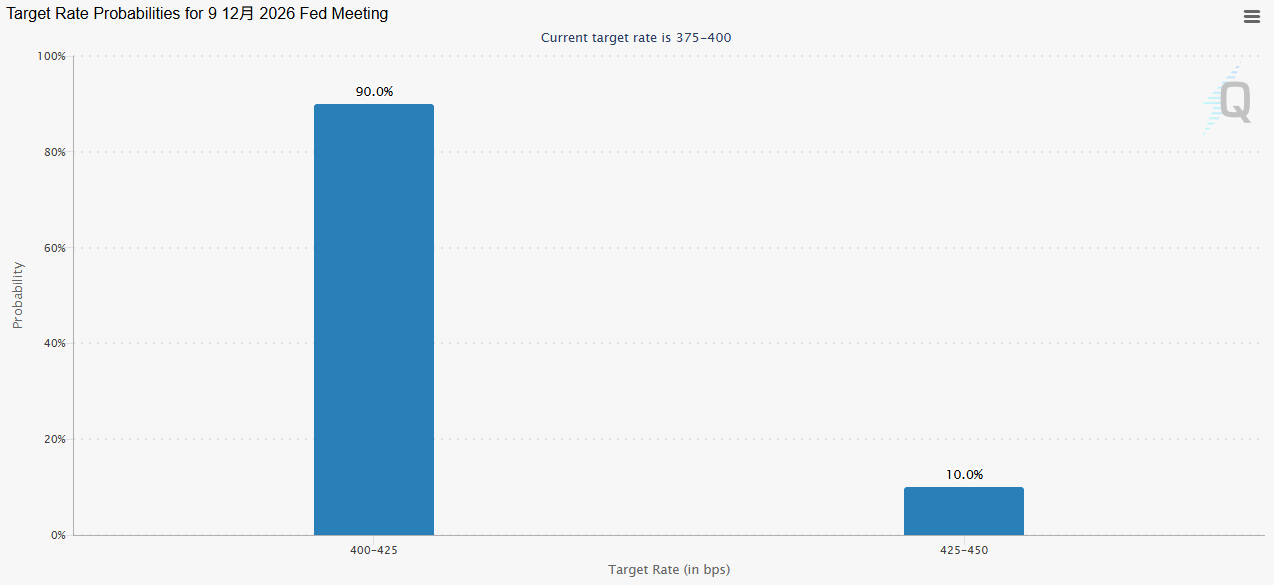
At the time of the report, CME data put the probability of a 25-basis-point December increase at 90%, versus 10% for 50 basis points. The probability of a cumulative 50-basis-point increase by January 2027 was 75.5%. Taken together, those prices favored two 25-basis-point moves, but they were market-implied probabilities, not a Fed commitment. BMO Capital Markets economist Scott Anderson said the October minutes reinforced expectations of consecutive increases. LPL Financial economist Jeffrey Roach, by contrast, expected improving inflation readings over the next two months and considered a December increase of 25 basis points sufficient.
The pressure extended beyond crypto: over the preceding 24 hours, spot gold fell 3.6%, silver about 5%, London copper more than 4% intraday, and London tin more than 8% at one point. Economist Robin Brooks noted that lower oil prices had reduced inflation expectations implied by the US Treasury market. The Fed minutes, however, identified persistent price increases in core services excluding housing and demand for AI infrastructure pushing up some technology-product prices. Lower energy prices alone might therefore do little to settle expectations for January.
What the Bitcoin market evidence shows
Bitwise chief investment officer Matt Hougan wrote on November 17 that stronger-than-expected US inflation had raised the probability of a December rate increase, while roughly $2 billion in leveraged positions were liquidated during a thinly traded weekend, amplifying Bitcoin’s decline. K33 research head Vetle Lunde pointed to more than half of circulating Bitcoin being held at a loss, negative perpetual-futures funding rates and elevated demand for options protection—conditions he compared with earlier interim lows. Those signals describe market stress; they do not establish that a bottom has formed.
The evidence for a sustained recovery was also limited. Wintermute OTC trader Jasper de Maere said the rise since July’s low might have been a false breakout and saw no clear buying support from ETFs, crypto treasury companies, retail traders or institutions. Talos data showed that the total value of orders within 1% of Bitcoin’s mid-price was down nearly 38% from its year-to-date high before the Binance theft cited in the report. A thinner order book means a trade of the same size can move the price further in either direction; it does not, by itself, predict which direction comes next.
Analysts disagreed on the significance of $62,000. Bitget analyst Lewis Huang noted that Bitcoin had fallen below its roughly $68,000 200-week moving average and said a further rise in the dollar and Treasury yields, combined with a break below $62,000, could prolong selling. Sygnum Bank chief investment officer Fabian Dori likewise saw a risk from sustained dollar and long-term Treasury-yield strength, while saying the counterweight would depend on institutional allocation and demand for a hedge against currency depreciation.
Fidelity’s Jurrien Timmer remained constructive on Bitcoin’s broader cycle because its price was near support in his long-term model, while acknowledging that a decisive break would test the model. Wellington-Altus strategist James Thorne identified a bullish weekly-chart pattern but placed its invalidation level at $57,000. Trader Peter Brandt instead warned of a possible head-and-shoulders top, with greater downside risk if the pattern were confirmed.
The reported positioning and liquidity measures explain why traders were watching both $62,000 and the Fed’s next signals. They do not resolve whether the level is a durable floor: that depends on subsequent inflation and policy news, as well as whether spot buying returns to a thinner market.