In a November 15, 2026 report, BlockBeats cited on-chain analyst Specter’s warning about claims that the Ethereum Foundation was selling ETH. Specter argued that some wallets cited in those claims had been labeled as Foundation-linked without sufficient evidence of ownership.
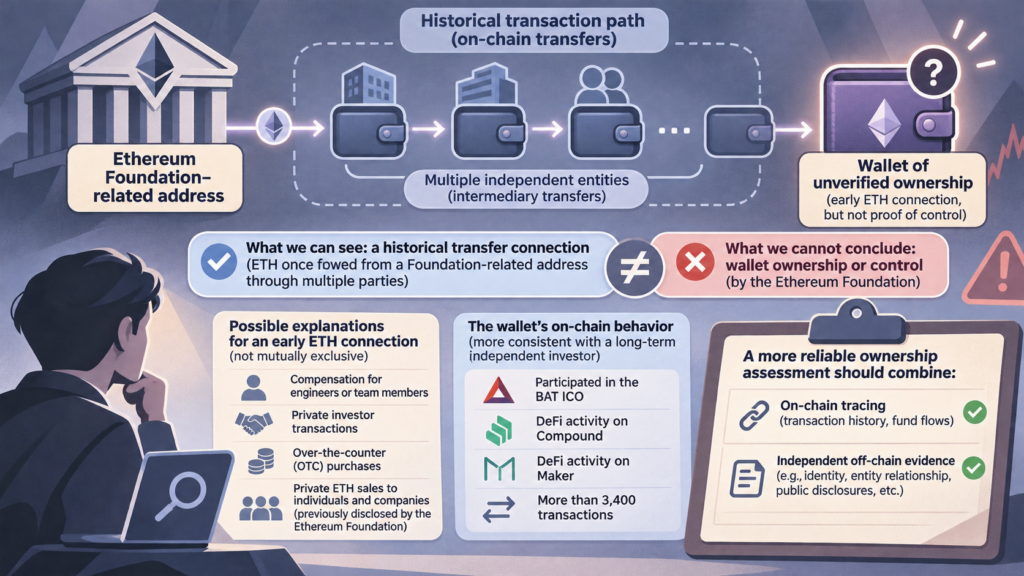
Specter pointed to one wallet whose early funding history could be traced to Foundation-related addresses, but only through transfers involving multiple independent entities. The wallet had participated in the BAT ICO and DeFi activity involving Compound and Maker, and had made more than 3,400 transactions. Specter said that pattern was more consistent with a long-term independent investor than proof of a Foundation-controlled wallet.
There are other possible explanations for an early ETH connection. Specter noted that distributions could have been compensation for engineers or team members, private investor transactions, or over-the-counter purchases. The Ethereum Foundation also disclosed in January 2016 that it had made approximately $650,000 worth of private ETH sales to individuals and companies. None of those possibilities establishes how the wallet in question acquired its ETH.
The methodological distinction is between tracing a transfer and identifying an owner. A historical transaction link does not, by itself, show that two addresses are held or controlled by the same entity. Specter warned that labeling every wallet with a past Foundation funding connection as a team wallet could fuel unwarranted market concern; a stronger ownership assessment would require both on-chain tracing and independent off-chain evidence.