
Bitcoin fell to a session low of $57,500 on November 25, 2026, as U.S. stocks sold off. The pressure on Bitcoin holders predated that morning’s inflation release: U.S. spot Bitcoin exchange-traded funds had already recorded their largest monthly net outflow since launch, and on-chain data showed investors realizing unusually heavy losses.
Through November 24, investors had withdrawn a net $4.94 billion from U.S. spot Bitcoin ETFs for the month, according to Decrypt’s ETF tracker. With November still underway, net withdrawals had already exceeded those of any full month since the funds launched in January 2024.
Glassnode reported a different measure of stress on November 24. Relative to the money that had flowed into Bitcoin over the preceding year, investors were realizing their heaviest losses since the November 2022 collapse of FTX and the market crash that followed. That comparison concerns losses relative to inflows, not an absolute dollar record. Neither measure establishes what drove Bitcoin to its November 25 low.
Inflation and growth put a December rate increase in focus
The Bureau of Economic Analysis revised third-quarter U.S. GDP growth from 3.4% to 4.3% at an annualized rate, up from 2.2% in the second quarter. Yet consumer spending in October was flat after inflation, even as it rose in dollar terms.
The Personal Consumption Expenditures price index, the Federal Reserve’s preferred inflation gauge, rose 3.8% year over year in October, up from 3.6% in September and matching the three-year high reached in May. Excluding food and energy, inflation rose from 3.1% to 3.3%, above economists’ 3.2% expectation. “America’s inflation problem is bigger than an energy shock,” Heather Long, chief economist at Navy Federal Credit Union, told AFP.
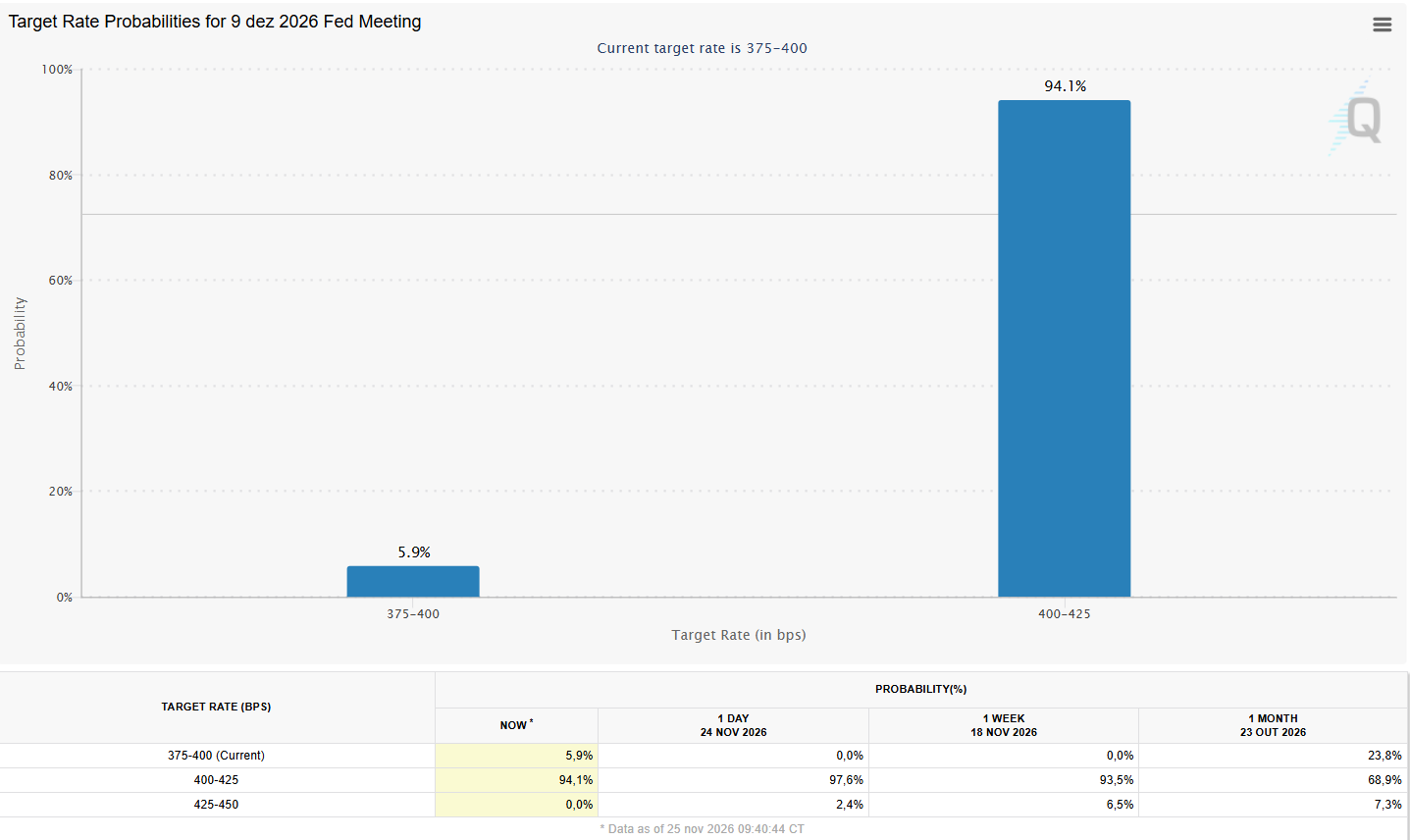
Stronger growth gave the Fed more room to raise rates while inflation remained above its 2% target. CME FedWatch put the market-implied probability of a quarter-point December increase at 98% after the inflation release; a later reading put it at 94%. Traders were also pricing in further tightening as early as January 2027. The Fed had held its rate range at 3.75%–4% in October after September’s increase, its first in three years. Its next decision was scheduled for December 9.
Proposed tariffs and a broad market decline
The Office of the U.S. Trade Representative proposed duties targeting 14 economies, including China, the European Union, Japan and South Korea, after investigating policies that encourage manufacturing beyond market demand. Proposed duties varied by product and economy, reaching up to 20% on some Chinese imports and 35% on Vietnamese goods, subject to adjustments and exemptions. The proposed 15% EU rate counted certain existing duties rather than adding 15 percentage points to them. The tariffs had not taken effect. Public hearings were scheduled to begin January 25, and any additional pressure on consumer prices would depend on whether importers passed on the costs.
By 9:50 a.m. ET on November 25, the Nasdaq Composite was down 4.3%, the S&P 500 was down 3% and Nvidia had fallen 8.7%. Nvidia’s 31.5% gain on November 23 following Jensen Huang’s return had already given way to a decline of more than 6% on November 24. Anthropic closed that day at $81.91, below its $83 offering price less than a week after its Nasdaq debut. Higher rates make data centers more expensive to finance and reduce the present value of earnings that AI companies expect years from now.
The decline extended beyond U.S. technology stocks and Bitcoin. Before Wall Street opened, South Korea’s Kospi had closed 6.16% lower. Spot gold was down 2% to $3,483.59 an ounce by 9:15 a.m. ET, according to Reuters.