
In Praxis, a cryptography preprint cleared for posting on November 23, 2026, David Tse, Nikhil Vanjani and Psi Vesely propose a more efficient way to encrypt information so that a valid mathematical proof unlocks it. Their calculations suggest that researchers could test Bitcoin bridge designs with far less encrypted data and computing work than some earlier schemes require. The estimates cover the encryption scheme, not the cost of running a bridge.
What the encryption estimate covers
In the paper’s example, the authors calculate that the encrypted package would occupy 7.88 GiB at their stated 100-bit security level. For the same proof condition, key length and stated security level, they estimate that the package size and the work required to encrypt it would each be less than one ten-billionth of the corresponding figure they calculate for earlier designs by Hair and Sahai. The comparison uses calculated sizes and operation counts, not measured bridge performance, and the schemes rely on different security assumptions.
The proposed technique, called witness encryption, makes access to information depend on evidence that a specified condition holds. Earlier research called BABE used witness encryption for one particular mathematical check. Praxis is designed for a broader class of conditions: a solution must be efficient to check, even if it takes more work to find. In the paper’s Groth16 example, anyone who produces or obtains a valid proof for the specified condition can recover the key that opens the encrypted data.
What Bitcoin would verify
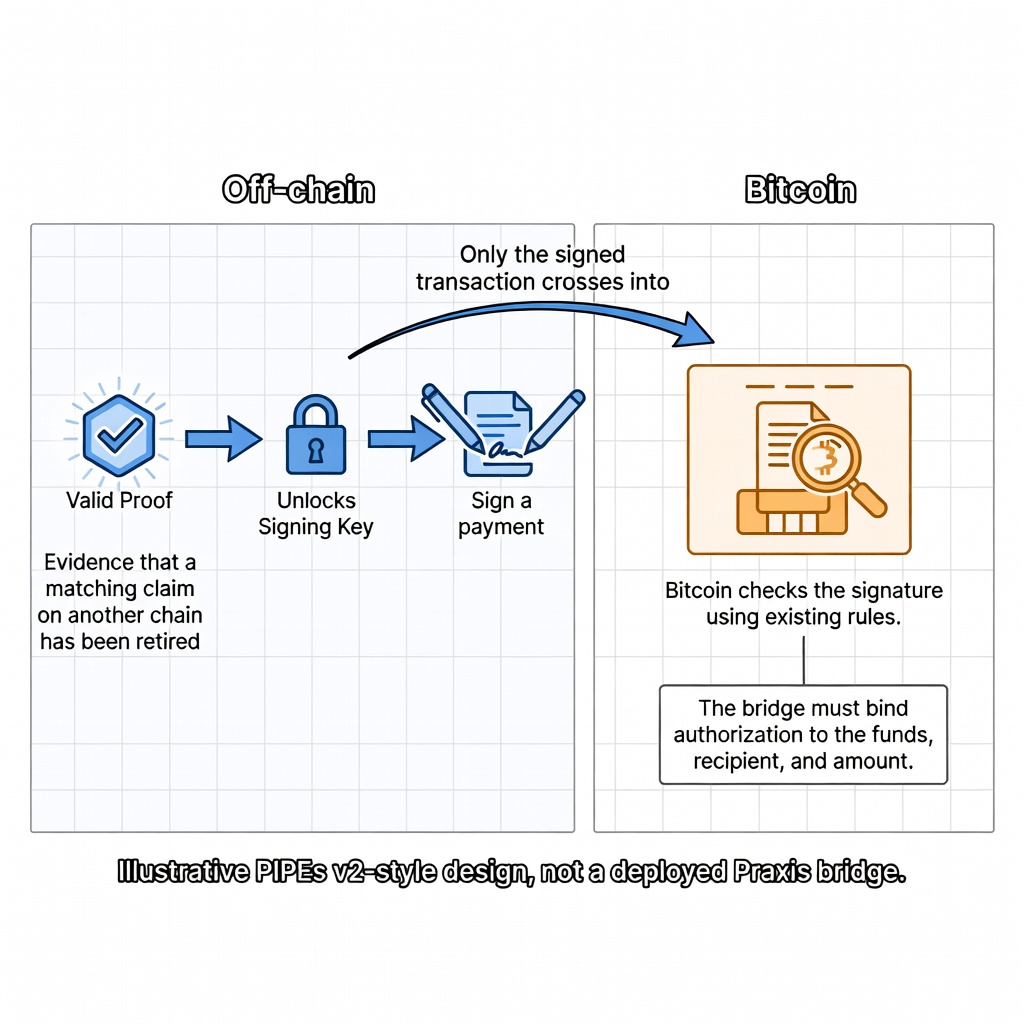
The earlier Bitcoin PIPEs v2 proposal illustrates why that distinction matters for payments. Rather than asking Bitcoin’s limited scripting language to verify a complex proof, PIPEs v2 puts a Bitcoin signing key behind a proof condition. A valid proof releases the key off-chain. Bitcoin then checks the resulting transaction signature under its existing rules.
Consider a bridge that locks bitcoin on the mainnet and issues a matching claim on another chain. To withdraw, the holder would give up that claim. A proof that the claim had been retired could unlock the authority to sign a Bitcoin payment. Bitcoin would check the signature, not whether the claim had been retired. The bridge would therefore need rules tying the proof and signing authority to the intended funds, amount and recipient. Praxis proposes an encryption mechanism, not those withdrawal rules.
A working bridge would also need to make several gigabytes of encrypted data available at withdrawal. The authors count the work of opening the package only once a valid proof is available; producing that proof takes additional time and computing power. Finally, the Groth16 example requires an honestly run setup. According to the authors, anyone who retained the setup secret could create proofs that pass verification and open packages tied to that setup. Reducing encryption costs does not remove that trust requirement.