Argentina’s central bank informally asked several digital wallets and crypto platforms to discourage trades involving stablecoins and the MEP dollar, a dollar exchange rate derived from bond trades. In a Nov. 27, 2026 report, Crypto.news cited five financial-sector executives who spoke to iProUP. One said the central bank, known as the BCRA, specifically raised conversions from Tether’s USDT into MEP dollars with crypto platforms.
The executives said the BCRA wanted to keep the gap between the MEP and official exchange rates from widening. They described the contacts during the holiday-shortened week as recommendations, not orders. Routine trading continued, and one executive said the bank had not asked providers to stop customers from buying or selling foreign currency. The report did not identify the recipients.
What the 5.8% premium measured
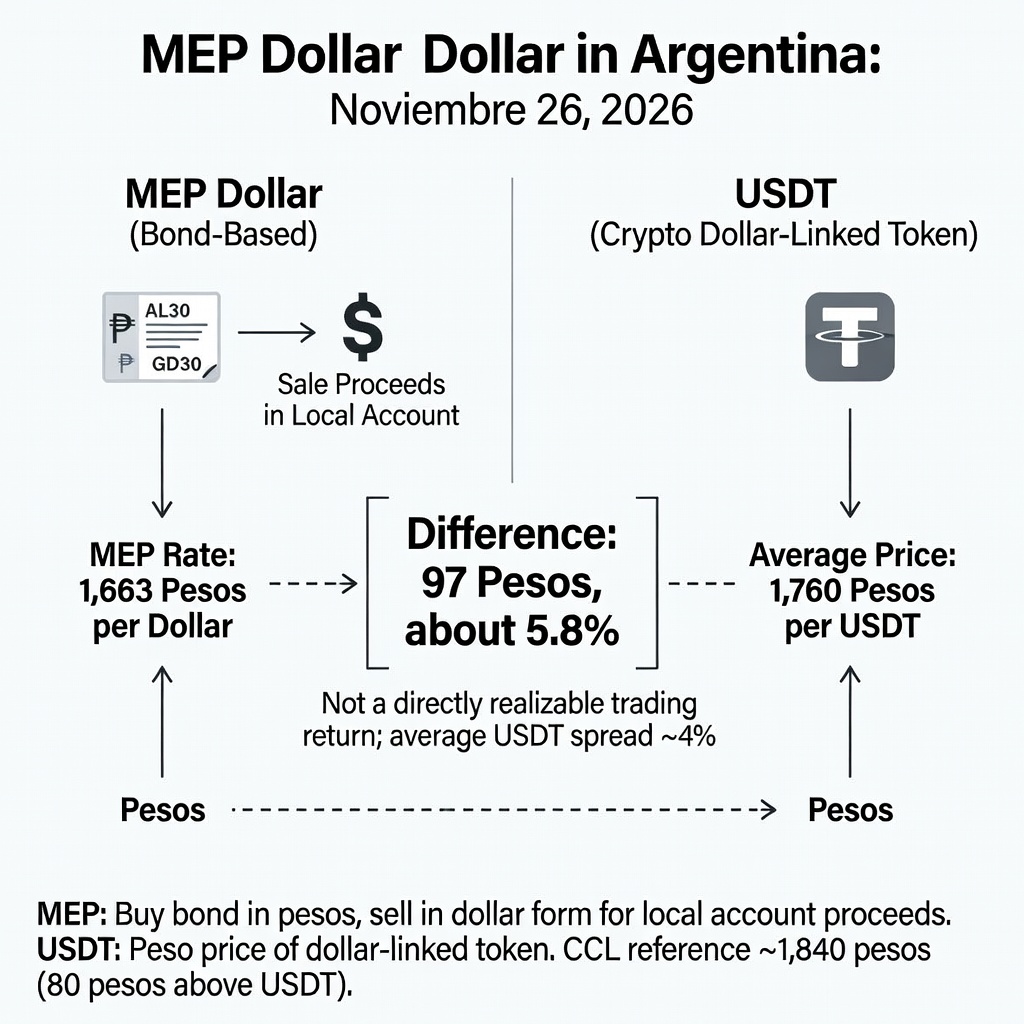
On the afternoon of Nov. 26, USDT averaged 1,760 pesos, while the MEP rate was 1,663 pesos per dollar. The difference of 97 pesos, or about 5.8%, compared two ways of obtaining dollar exposure. It was not the gap between the MEP and official rates that executives said concerned the BCRA.
A customer using the MEP market buys a bond such as AL30 or GD30 in pesos, then sells it in its dollar-denominated form. The sale proceeds go to a local account. Dividing the pesos spent by the dollars received gives the effective MEP rate. The USDT quote, by contrast, is the peso price of a dollar-linked token. Crypto platforms also refer to the contado con liquidación (CCL) rate when setting quotes. At around 1,840 pesos per dollar that afternoon, the CCL was about 80 pesos above the USDT price.
The 5.8% premium was not a directly realizable trading return: the report put the average spread between USDT buy and sell quotes at 4%. Nor do the quotes establish how much USDT customers converted into MEP dollars. An Aug. 30 analysis by a16z Crypto, cited by Crypto.news in September, found that stablecoins accounted for 94% of peso-denominated volume in markets tracked by Artemis. That figure measures stablecoin trading in those markets, not USDT-to-MEP flows.
Where the existing rules apply
The informal request was distinct from restrictions already in force. BCRA Communication A 7506, issued in May 2022, bars financial institutions from carrying out or facilitating digital asset transactions that lack regulatory authorization. A May 2023 notice extended a similar restriction to payment providers that offer payment accounts. Separately, Argentina’s National Securities Commission maintains the register for virtual asset service providers. An October resolution set Nov. 1 as the start of periodic reporting on customers, transactions and assets held in custody.
According to the executives, Mercado Pago and Cocos can offer MEP dollars through the securities market, even though their access to the official dollar through a partner bank was cut off in 2025. Neither was identified as a recipient of the BCRA’s recommendations. The reporting did not establish that any operator had changed its conversion process or pricing in response.