Historical source note: This analysis is based on an article published on November 11, 2026, at 19:35 (UTC+8). The performance figures and design descriptions below are claims in that article, not independently measured results.
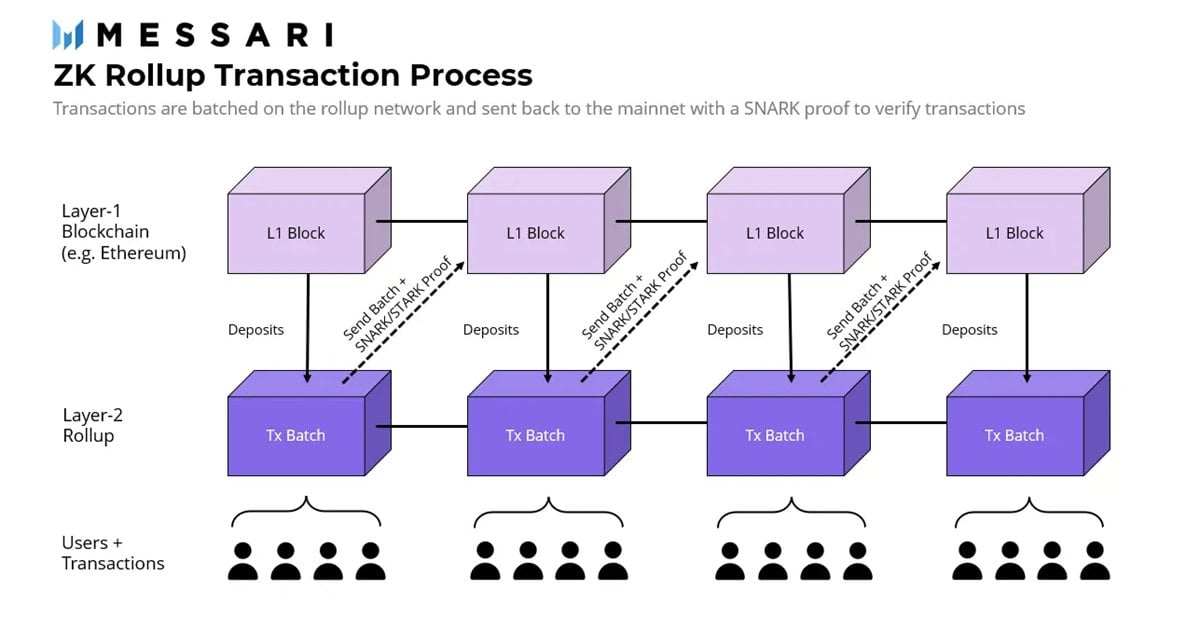
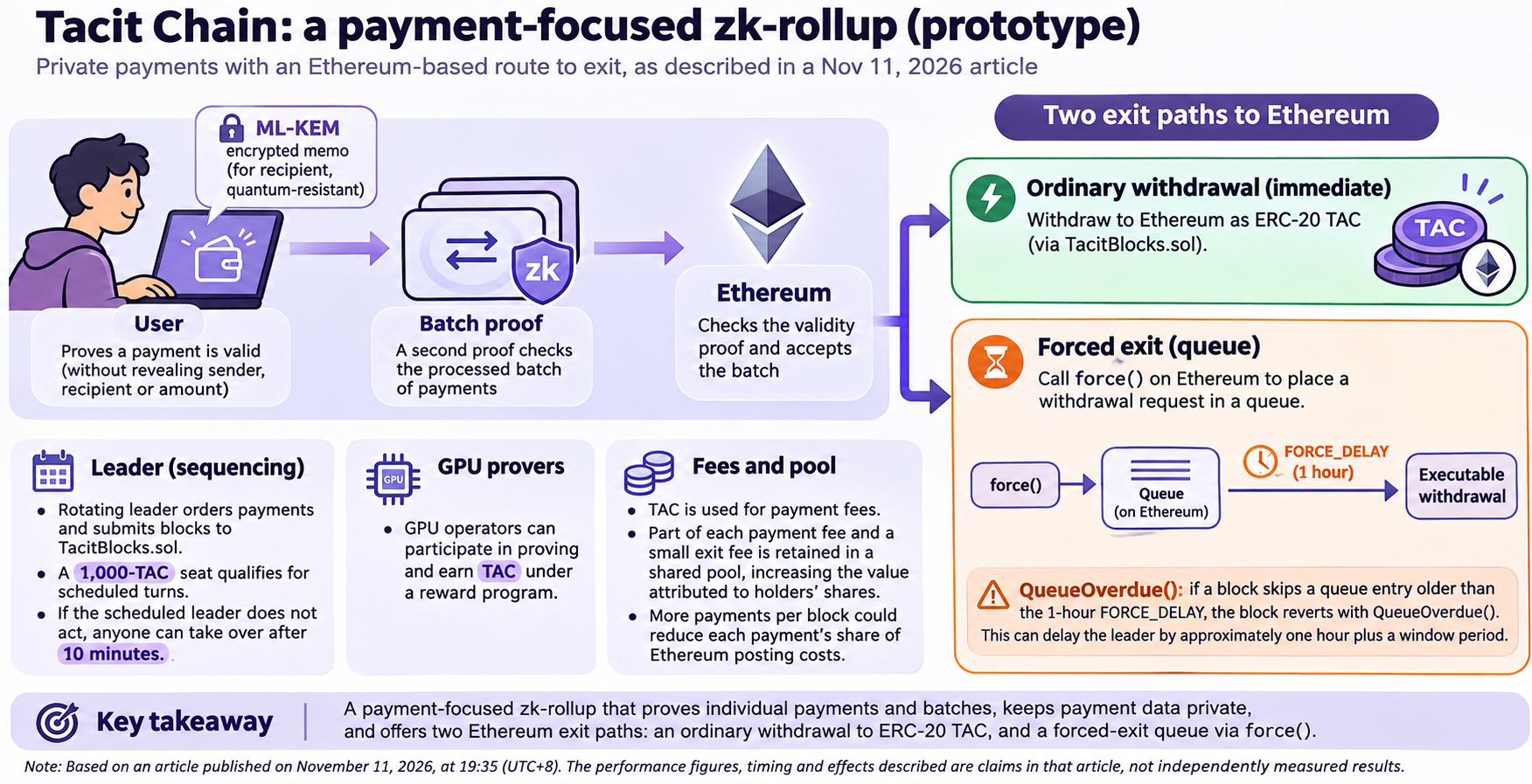
Tacit Chain is described as a payment-focused zk-rollup prototype: users prove individual payments, a second proof covers the processed batch, and Ethereum checks that proof before accepting the batch. Its intended distinction is private payment data with an Ethereum-based route to exit. The key research question is how much of that design can be assessed from the published description alone.

Why use a validity rollup?
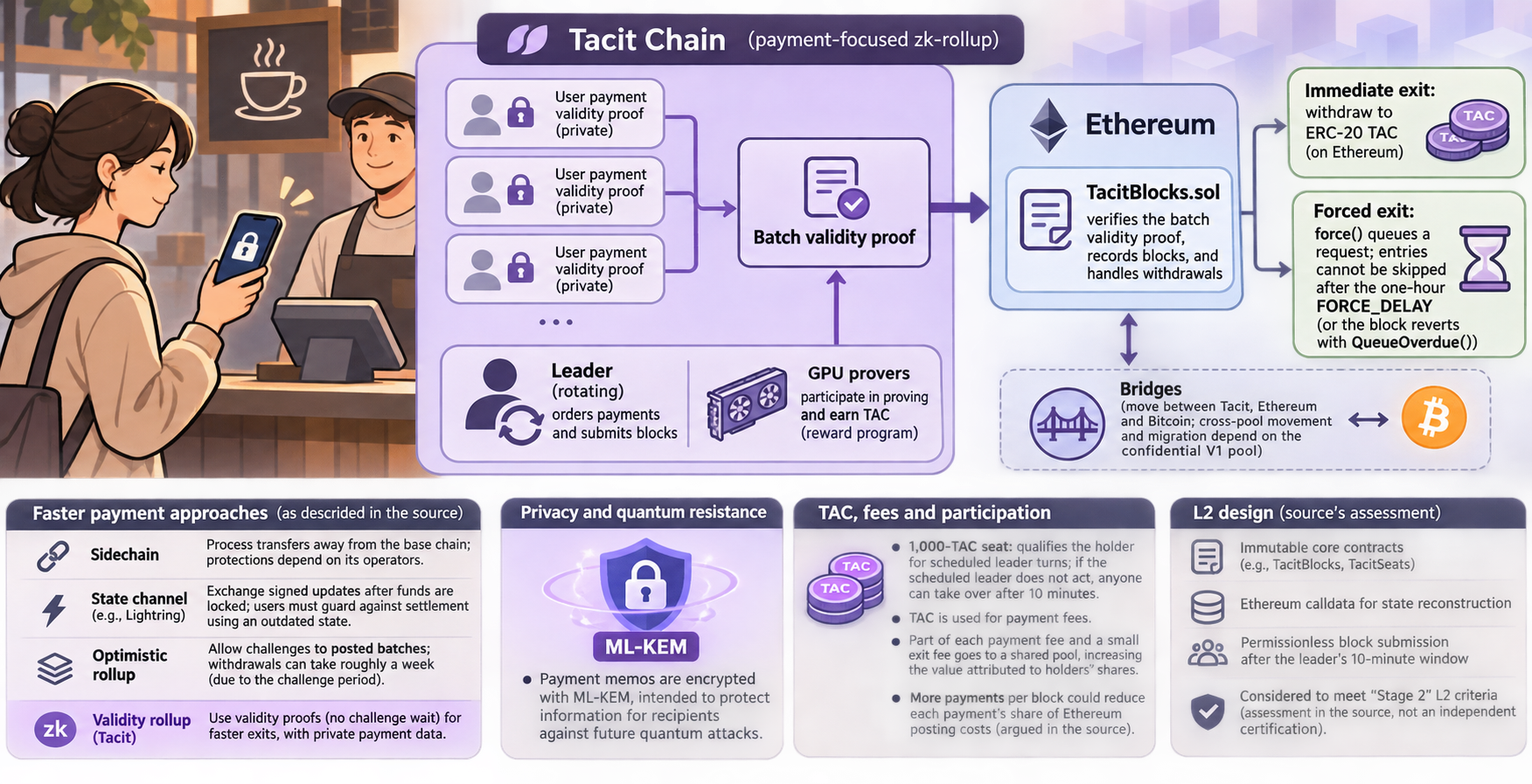
The source contrasts three approaches to faster payments. A sidechain can process transfers away from its base chain, but its protections depend on its operators. State channels, such as those used by Lightning, exchange signed updates after funds are locked, while users must guard against settlement using an outdated state. Optimistic rollups allow challenges to posted batches; the challenge period can make withdrawals take roughly a week.

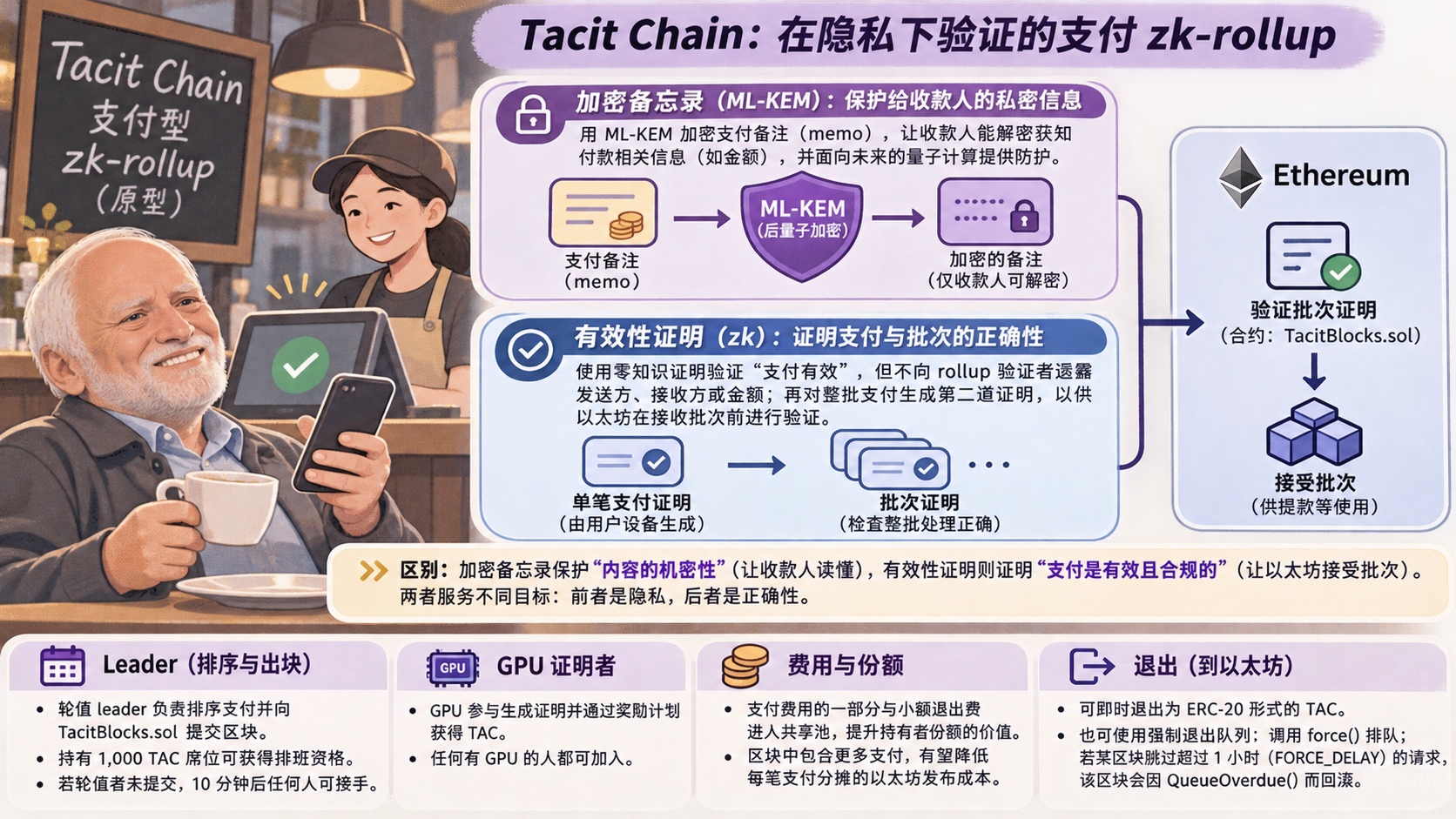
Tacit instead uses validity proofs. According to the article, a user’s device proves a payment is valid without revealing its sender, recipient or amount to the rollup verifier. A further proof checks the batch before Ethereum accepts it. This removes the optimistic-rollup challenge wait, but the source does not provide independent measurements of proof generation, payment latency or operating costs.
Sequencing, fees and exits
A rotating leader orders payments and submits blocks to the Ethereum contract TacitBlocks.sol, which records blocks and checks validity for withdrawals. The article says a 1,000-TAC seat qualifies its holder for scheduled turns; if the scheduled leader does not act, anyone can take over after 10 minutes. GPU operators can participate in proving and earn TAC under a reward program. TAC is also used for payment fees.
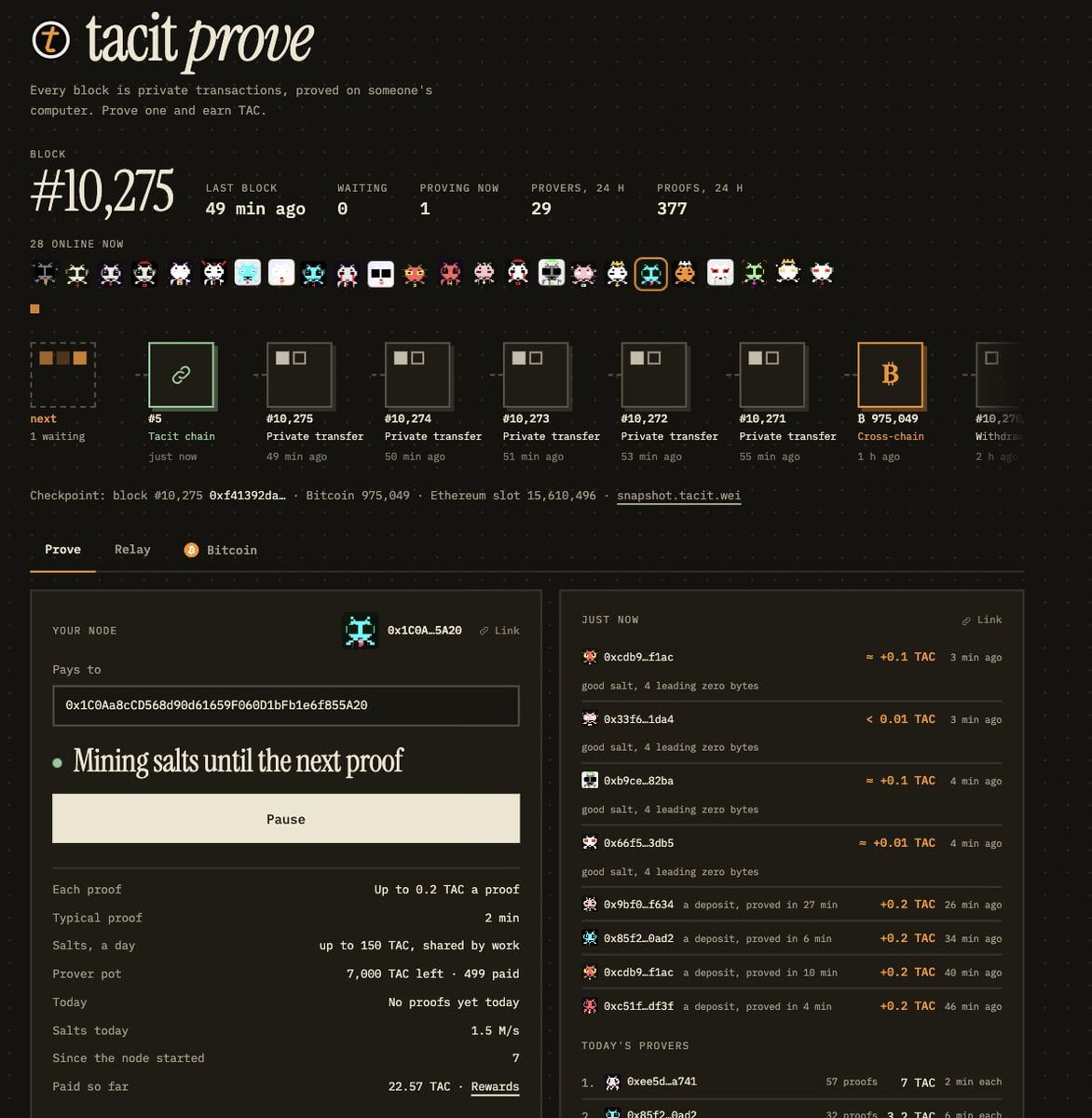
The described fee model retains part of each payment fee and a small exit fee in a shared pool, increasing the value attributed to holders’ shares. The article argues that more payments per block could reduce each payment’s share of Ethereum posting costs. These are mechanism descriptions and projected effects, not a supplied fee dataset or valuation model.
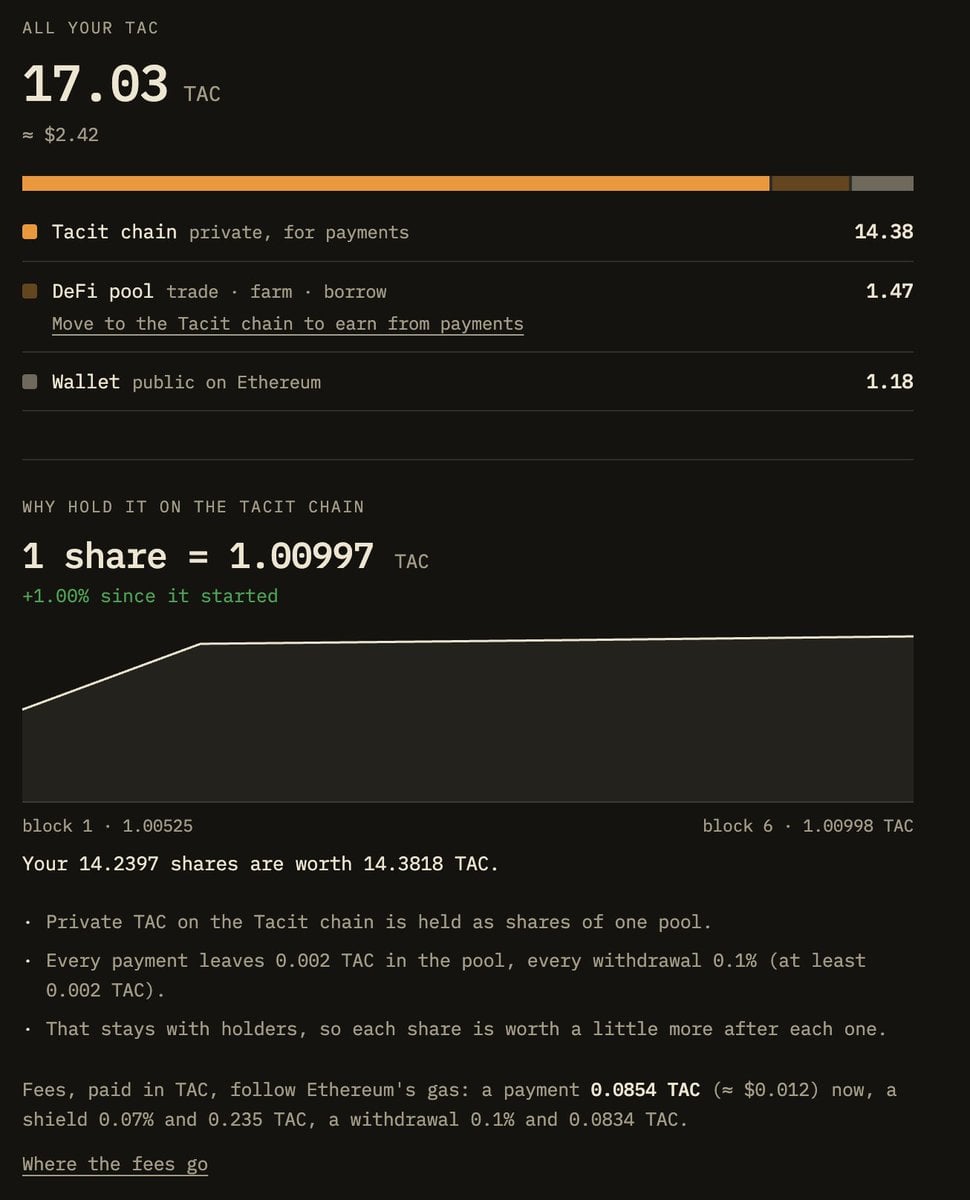
For an exit to Ethereum, the source describes an immediate withdrawal into ERC-20 TAC. It also describes a separate forced-exit queue: force() places a request on Ethereum, and a block that skips an entry older than the one-hour FORCE_DELAY reverts with QueueOverdue(). The article characterizes the resulting leader delay as approximately one hour plus a window period. Bitcoin movement involves bridges; cross-pool movement and migration depend on the construction of a confidential V1 pool, whereas an exit to Ethereum as TAC does not depend on that pool, according to the source.
Privacy claims and unresolved evidence
The article says payment memos use ML-KEM to protect encrypted information intended for recipients against future quantum attacks. It also argues that Tacit meets Stage 2 L2 criteria, citing immutable core contracts, Ethereum calldata for state reconstruction and permissionless block submission after the leader’s 10-minute window. That classification is the author’s assessment, not an independent certification established by the supplied material.
The source claims a merchant can see a payment when sent and that Ethereum finality follows in about one minute. It presents confirmation approaching 30 seconds and costs below one cent as prospects tied to stronger participation and blob use. No dated benchmark, underlying transaction dataset or reproduced test accompanies those figures. On this evidence, Tacit’s architecture and stated trust assumptions can be examined, but its payment performance and privacy guarantees cannot be independently verified.
Source: techflowpost.com (originally published 2026-11-11 19:35 UTC+8)