Historical report: originally published November 8, 2026, at 23:51 UTC+8.
Ethereum co-founder Vitalik Buterin argued that ETH’s case as a store of value rests more on Ethereum’s ability to endure than on the amount of ETH it burns in transaction fees. He supports retaining the burn introduced by EIP-1559, but said holders “should not feel sad” even if it remains below 10% of the level needed to offset new issuance indefinitely.
The limits of a burn-based valuation
In an X thread reported by The Block, Buterin described a model that values a token by dividing its annual burn by a discount rate. His illustration—a hypothetical $1 billion annual burn and a 4% discount rate—produces a $25 billion valuation. He cautioned that this is not a dependable floor: much of Ethereum’s 2021–2023 burn came from activity within crypto, whose associated fees could decline alongside ETH’s price.
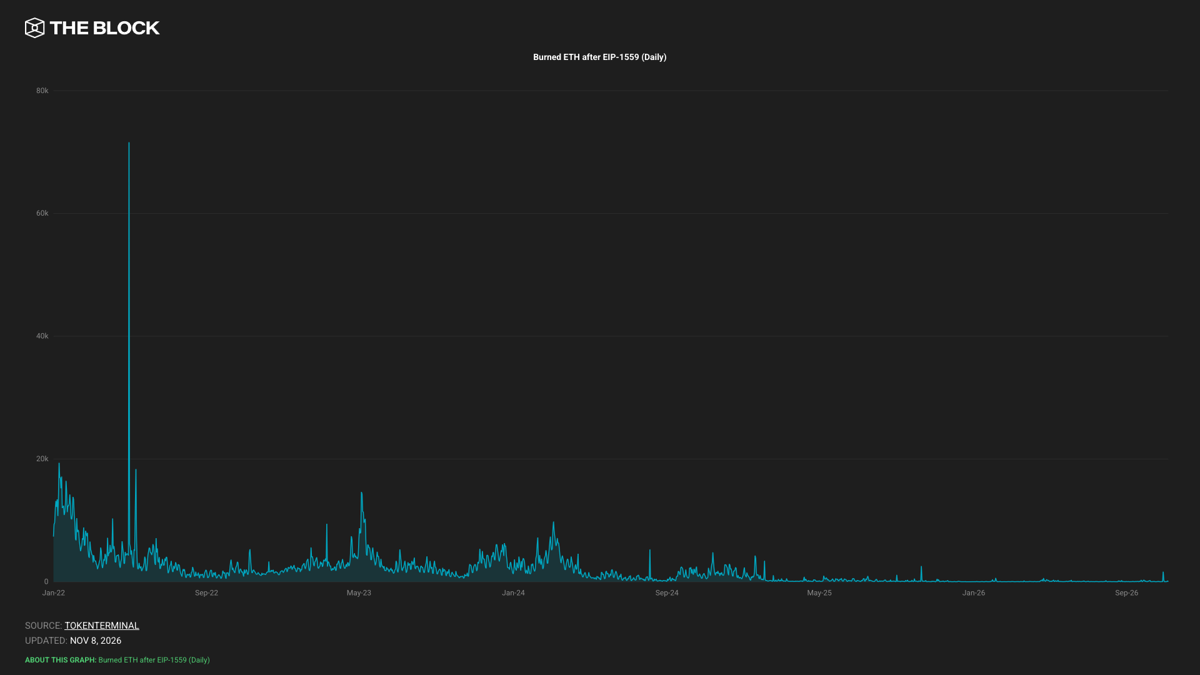
The Block’s daily ETH-burn chart shows the spike around the Otherdeed sale. Its reported totals were approximately 1.48 million ETH burned in 2022, versus 19,200 ETH so far in 2026 as of the November 8 report. Those are burn measurements, not evidence that ETH has a valuation floor. Buterin said tokenized real-world assets could provide a stronger claim to activity backed by demand outside crypto, though he did not expect a mature market for such assets to generate comparable fee spikes.
What optimizing for burn would require
Buterin put ETH’s market capitalization at roughly $270 billion and argued that sustaining a valuation on fee burn alone could demand substantial ongoing protocol spending and interventionist governance. Using an AI-generated estimate of L’Oréal’s research-and-development spending as an analogy—not a measured Ethereum funding requirement—he suggested comparable in-protocol funding would amount to roughly 700,000 ETH annually and reduce validator revenue by two-thirds. He also warned that pursuing higher fee burn could mean higher gas prices, potentially excluding users who need privacy and security.
His alternative emphasis is on survival and properties he calls CROPS: censorship and capture resistance, open source, privacy and security. He cited work on lightweight nodes, privacy and censorship resistance as relevant to that goal. This is Buterin’s argument for ETH as a store of value, not a demonstrated valuation model or a prediction of returns.
The discussion followed the withdrawal of EIP-8363, a proposal that would have burned an increasing share of validator rewards as more ETH was staked. Its withdrawal matters to the distinction: that proposed change was not an enacted Ethereum rule.
Source: theblock.co (originally published 2026-11-08 23:51 UTC+8)