
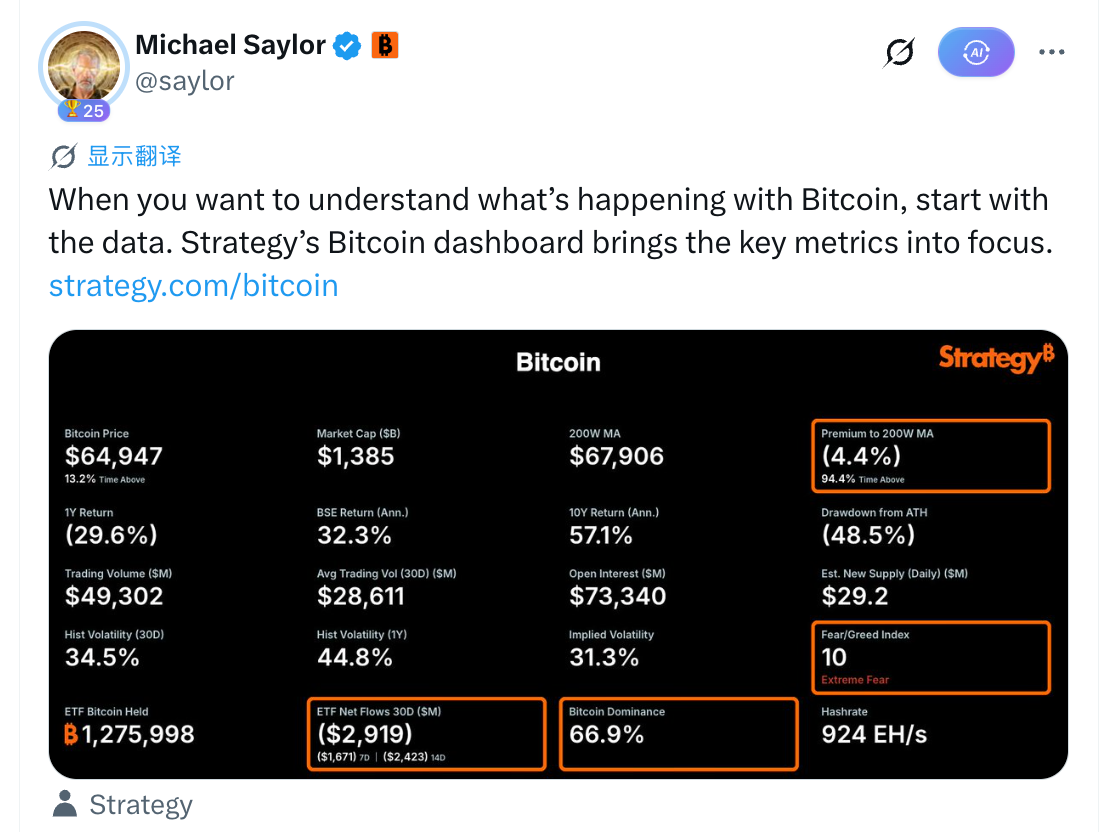
On November 16, 2026, Michael Saylor shared a screenshot of Strategy’s Bitcoin dashboard on X and highlighted four measures: the 200-week moving average, spot ETF flows, market sentiment and Bitcoin’s share of total crypto market value. The figures describe a market under pressure at the time of the report. They do not, on their own, establish whether Bitcoin had reached a bottom.
Price and fund flows
Strategy’s dashboard showed Bitcoin at $64,947, below its 200-week moving average of $67,906—a reported −4.4% difference. The dashboard also indicated that Bitcoin had traded above that average for 94.4% of its historical trading time. The report did not specify the calculation period or methodology behind that historical comparison. A moving average measures past prices; it is not a direct measure of holders’ cost basis.
The dashboard recorded cumulative net outflows from spot Bitcoin ETFs of $2.919 billion over 30 days, including $2.423 billion over 14 days and $1.671 billion over seven days. Those overlapping windows show that much of the reported 30-day outflow fell within the most recent two weeks. ETF flows alone do not identify who sold or why.
Sentiment, positioning and market share
The reported Fear and Greed Index reading was 10, classified as “Extreme Fear.” Bitcoin futures open interest stood at $73.34 billion. Open interest measures outstanding contracts, not whether traders collectively expect prices to rise or fall.
Bitcoin dominance—the asset’s share of total crypto market value—was 66.9%, while the dashboard showed Bitcoin 48.5% below its all-time high and down 29.6% over one year. Rising dominance during a decline indicates that Bitcoin’s market value held up better than the broader crypto market by this measure. It does not, by itself, prove that capital moved directly from other tokens into Bitcoin.
Taken together, the dashboard readings place price weakness alongside ETF outflows and fearful sentiment as reported on November 16. They offer a snapshot of market conditions, not a valuation verdict or a timing signal.