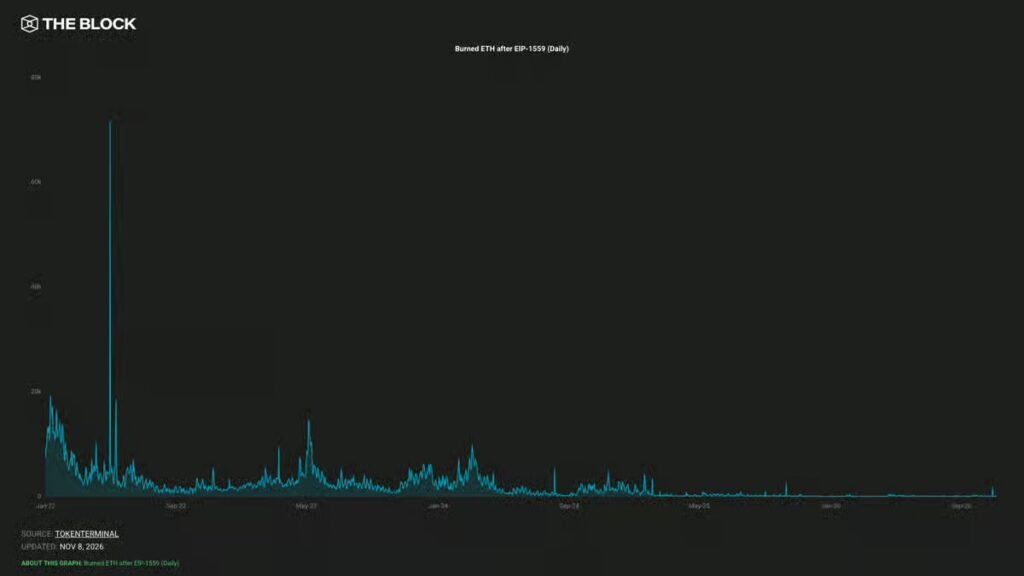
As reported on November 9, 2026, Vitalik Buterin argued that ETH is better understood as a store of value than as a token valued primarily through transaction-fee burns. He supported retaining EIP-1559, introduced in 2021, even if the ETH it burns offsets only part of new issuance. In his view, ETH’s value also depends on Ethereum’s decentralization and its ability to remain secure, private, censorship-resistant and operational over time.
Why the burn-based valuation is fragile
Buterin described a simple valuation model: divide the annual value of burned tokens by a discount rate. At $1 billion burned per year and a 4% rate, the result is $25 billion. He cautioned that this is not a dependable valuation floor. Much of the demand that drove burns from 2021 through 2023 came from within crypto and could contract alongside ETH’s price. He cited an NFT sale that generated $180 million in fee burns in one day; the article identifies it as Yuga Labs’ Otherdeed sale.
Buterin said the model would require fee-generating demand from outside the crypto economy to provide a firmer basis. He sees growing real-world asset tokenization as a better source of such demand, while cautioning that steadier businesses are unlikely to reproduce past fee spikes.
The Block’s burn data, as reported in the November 9 article, illustrates the change in scale: approximately 1.48 million ETH, worth about $3.6 billion, was burned in 2022, compared with approximately 19,200 ETH, worth $43 million, so far in 2026. Those figures describe different measurement periods; they are not a like-for-like annual comparison.
The cost of optimizing for burns
Buterin also questioned what it would take to support ETH’s market capitalization through burns alone. The Block’s market page put that capitalization at $273.3 billion on the morning of November 8. He compared such a model with a large company’s need to fund continuing work, citing an AI-generated estimate that L’Oréal spends about 0.58% of its market capitalization on research and development. Applying a comparable spending ratio to Ethereum, he argued, would require roughly 700,000 ETH a year in protocol-funded operations and reduce validator rewards by two-thirds. That comparison is his argument, not an independently established funding requirement for Ethereum.
More fundamentally, Buterin said making burns a long-term optimization target would require interventionist governance at odds with decentralization and resistance to capture. Prioritizing burns could also mean higher gas fees, excluding users who most need privacy and security.
His alternative test for ETH’s store-of-value case is whether the network can endure. He pointed to work on post-quantum security, privacy, censorship resistance and easier node operation, including Kohaku, FOCIL and light nodes. These are priorities he cited, not proof that every objective has been achieved.
The governance debate was already visible in EIP-8363, a proposal to increase the portion of validator rewards burned as ETH staking grew. Its co-authors had withdrawn it from consideration for the planned Hegota upgrade about five weeks before Buterin’s post. It was a proposal, not an enacted change.