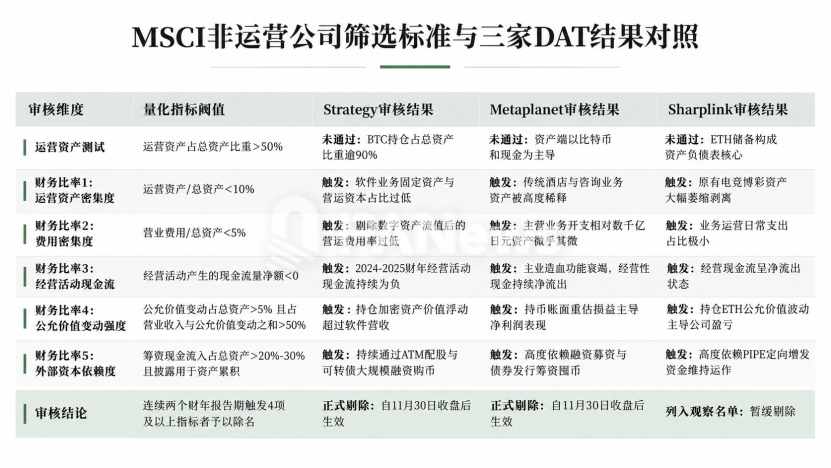
In a report published on November 12, 2026, PANews said MSCI had confirmed that it would remove Bitcoin treasury companies Strategy and Metaplanet from its indexes after the November 30 close. Ethereum treasury company SharpLink Gaming was placed on a watchlist. The distinction matters: the reported change directly affects index eligibility, while any effect on the companies’ ability to raise capital remains a question.
The classification test
PANews described MSCI’s decision as an application of a broader rule for non-operating companies, finalized on October 15 after an August consultation. The framework examines operating assets and five financial ratios. According to the report, a company that fails the operating-assets screen and at least four of the five ratios can be classified as a non-operating vehicle.
The rule also treats existing constituents differently from new candidates: PANews said a new candidate can be rejected after one non-compliant reporting period, whereas an existing constituent enters a watchlist after one period and faces removal after two full fiscal years of non-compliance. SharpLink was placed on the watchlist rather than removed. The report also identified UK uranium investor Yellow Cake among the removals, indicating that the classification was not limited to digital-asset treasuries.
An earlier, crypto-specific proposal would have excluded listed entities whose digital assets exceeded 50% of total assets. PANews said MSCI proposed it in October 2025 and withdrew it in early 2026.
What the reported holdings—and flow estimates—show
As of November 8, PANews reported that Strategy held 850,364 BTC, acquired for approximately $64.16 billion in total, while its enterprise-software revenue was $125.4 million in Q3 2026. It reported that Metaplanet, formerly focused on hotels and entertainment, had accumulated 44,000 BTC. These figures show why the treasury strategies are central to the classification question; they do not, by themselves, reproduce MSCI’s five-ratio test.
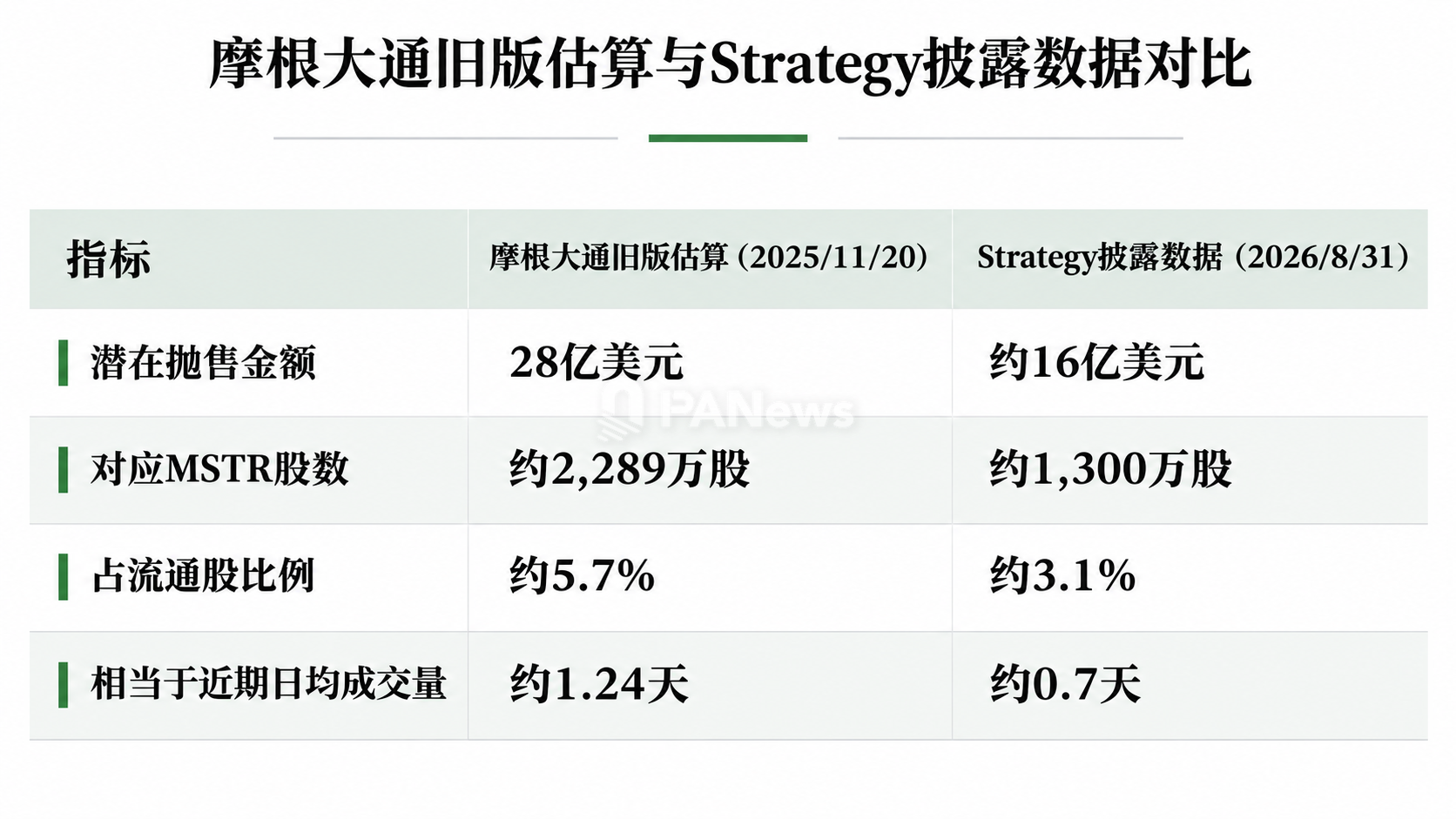
PANews cautioned against treating older sell-flow estimates as current forecasts. It attributed figures of $2.8 billion in possible passive selling following a Strategy exclusion, and as much as $8.8 billion in outflows if other index providers followed, to a JPMorgan report from November 2025. Share count, price and index holdings had since changed.
Using Strategy’s August disclosure of 13 million shares held by passive funds, the November 11 closing price of $122.35, approximately 402 million shares outstanding and 18.49 million shares in average daily volume over the preceding 30 trading days, PANews calculated potential selling of roughly $1.59 billion. That is about 3.2% of shares outstanding or 0.7 days of average trading volume. It is a scale estimate, not a measured sale or a forecast of market impact.
The financing question
Strategy’s equity-financing model depends in part on its shares retaining a premium to the net asset value of its Bitcoin holdings. PANews reported an mNAV multiple of 1.08 at the time of publication. Less index-linked demand could narrow that premium and make share issuance less attractive, but the report does not establish how much of the premium index funds provide.
PANews cited a Strategy 8-K filed November 9 stating that, from November 2 through November 8, the company sold approximately 2.05 million common shares for $283.8 million in net proceeds. Of that, $188.3 million went to repurchasing STRC preferred shares, $81.9 million to buying 1,036 BTC, and $13.6 million to cash reserves. The allocation illustrates competing uses for new capital; one week’s figures do not establish a lasting shift in strategy.
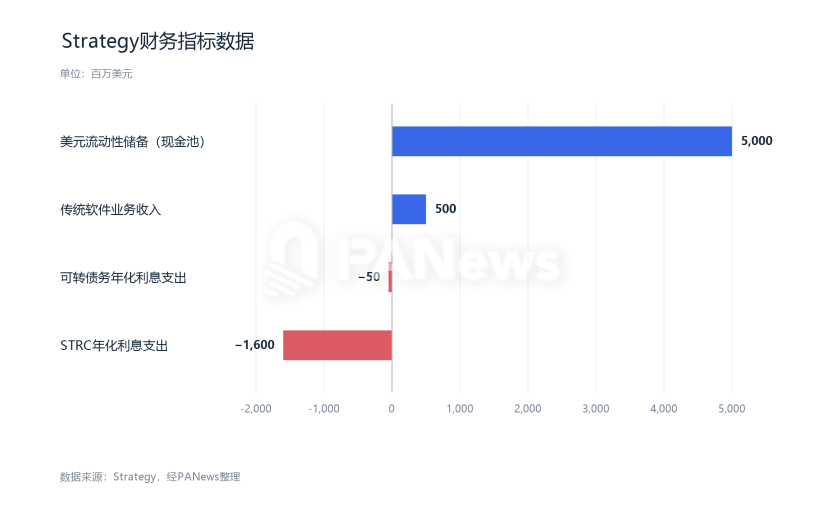
The report also cited a nearly $5 billion cash reserve and said approximately $1 billion of convertible principal begins to become redeemable in September 2027, with larger debt obligations concentrated in 2028–2030. It put annual software revenue at roughly $500 million and annual debt interest at approximately $50 million. Revenue should not be read as cash available for debt service without the associated costs and cash-flow figures.
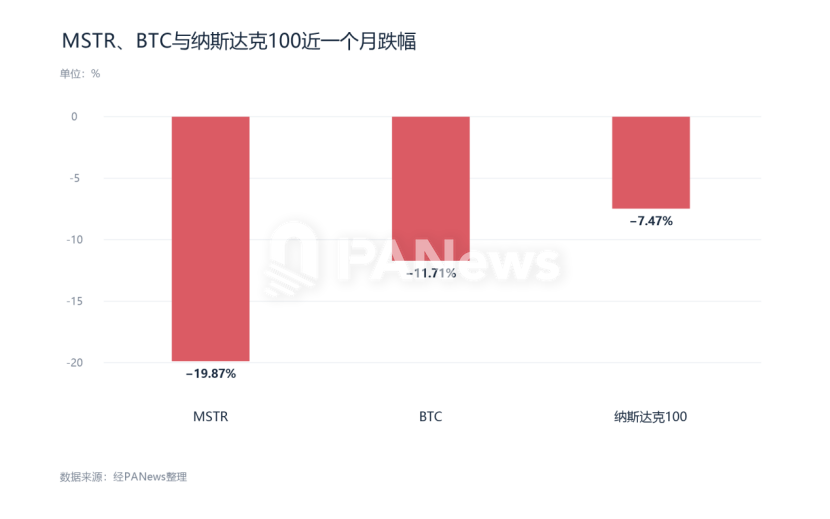
Finally, PANews compared Strategy’s share-price decline from $151.29 on October 15 to $122.35 on November 11—nearly 20%—with a Bitcoin decline of less than 10% over the same interval. The divergence is consistent with stock-specific risks, but it cannot isolate the index decision from financing costs, dilution or changes in the valuation premium. The documented event is an index-classification change; its longer-term effect on Strategy’s financing capacity remains uncertain.