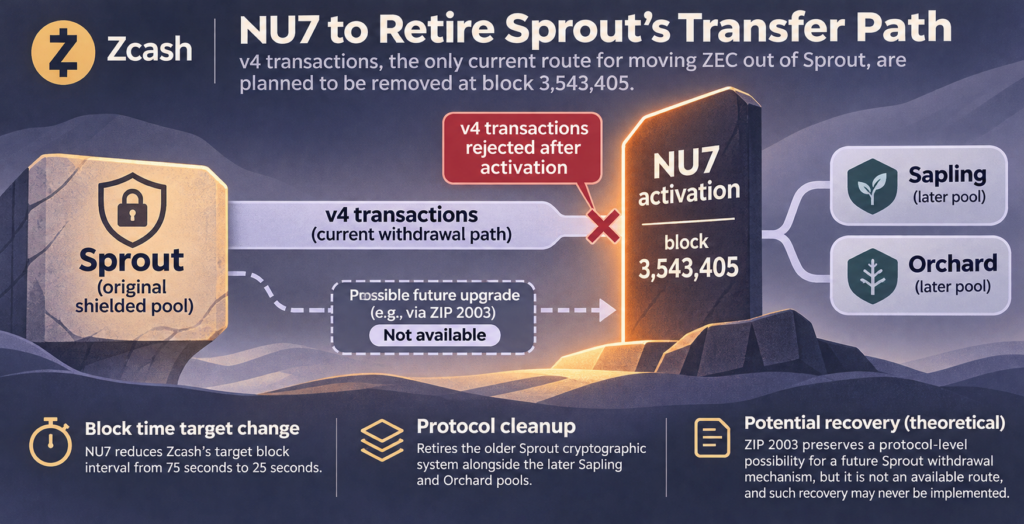
As reported on November 6, 2026, Zcash’s NU7 upgrade was set to activate at block 3,543,405. The consequential change for older funds is the planned removal of version 4 (v4) transactions—the format the report identifies as the only current route for moving ZEC out of Sprout, Zcash’s original shielded pool. The report did not establish that activation had already occurred.
What the cutoff means
Under the reported rules, nodes would reject v4 transactions after activation. A valid private key would therefore no longer be enough to move funds from Sprout through the existing transaction path. The report puts the remaining balance at approximately 12,226 ZEC, or roughly $16 million using an assumed price of about $1,300 per ZEC. It does not name the dataset or measurement time behind the pool balance.
The report also describes withdrawals before the cutoff: approximately 10,037 ZEC left Sprout over the preceding week, including a 9,094 ZEC net outflow on Sunday. By Wednesday, it says, daily outflow had fallen to about 40 ZEC. These figures show a slowdown in reported transfers; they do not establish why the remaining funds had not moved. Lost keys, unreachable owners and inactive cold storage are possibilities raised by the report, not verified explanations for those holdings.
Is recovery ruled out?
The report says the developer community approved ZIP 2003, which preserves a protocol-level possibility for a future Sprout withdrawal mechanism through another upgrade. That is not an available withdrawal route. According to the report, the specification warns that such a mechanism is only theoretically feasible and that stranded funds may never be recovered. The distinction is between losing the existing transfer path at NU7 and proving that recovery can never be implemented.
NU7 was also reported to reduce Zcash’s target block interval from 75 seconds to 25 seconds. That is a change to a target, not evidence here of measured transaction throughput or settlement times. The report frames Sprout’s retirement as removal of an older cryptographic system alongside the later Sapling and Orchard pools; it provides no independent security or performance measurements for that comparison.